

What about taking on rapidly increasing water rates?
Guest Commentary
by Mark Robak, Board Member, Otay Water District
What five members of the San Diego Local Agency Formation Commission (LAFCO) Board did Monday was incomprehensible, in blocking the proposed merger of the Fallbrook Public Utility District and the Rainbow Municipal Water District in North County. Worse yet, all five are Republicans; ones you think would want more efficient government.
LAFCO staff had recommended the merger go through, estimating it would save more than $2 million a year in reduced administrative and other costs.

Carlsbad City Councilmember Lorraine Wood, San Diego City Councilmember Lorie Zapf and Vista Irrigation District Jo MacKenzie joined San Diego County Supervisors Bill Horn and Dianne Jacob in rebuffing the recommendation.
So, what did these five officials hear that swayed them from saving money? Rainbow Water argued against the merger, saying they wanted “to retain local control,” which is generally the reason offered up by opponents fighting such consolidations.
Local control. That sounds good on the surface, but it’s not like a nameless faceless person from some other state would be taking over. It would have meant many of Rainbow’s existing board members as well as Fallbrook board members and others elected by the community. All local elected officials.
Why then was the consolidation considered by LAFCO in the first place? All consolidations, either voluntary or involuntary, go thru the agency, as the mission of each LAFCO (58 of them in California, one per county) is to provide assistance to local agencies in overseeing jurisdictional boundary changes.
In this case, a voluntary consolidation was initially jointly sought by Fallbrook and Rainbow. But after the voluntary effort between the two agencies fell apart, Fallbrook pursued forcing the consolidation.
Why did the voluntary consolidation efforts break down? Good question. For close to a year, Fallbrook and Rainbow did a functional consolidation of both agencies, including eliminating duplicate positions and sharing resources. The two agreed the savings were substantial, ranging from about $600,000 to close to $1 million annually.
Unfortunately, Rainbow backed out of the merger, even though it saved money, because its board members couldn’t agree on how they would get elected, either geographically or at large.
In other words, the Rainbow board members were afraid they might lose their elected seats.
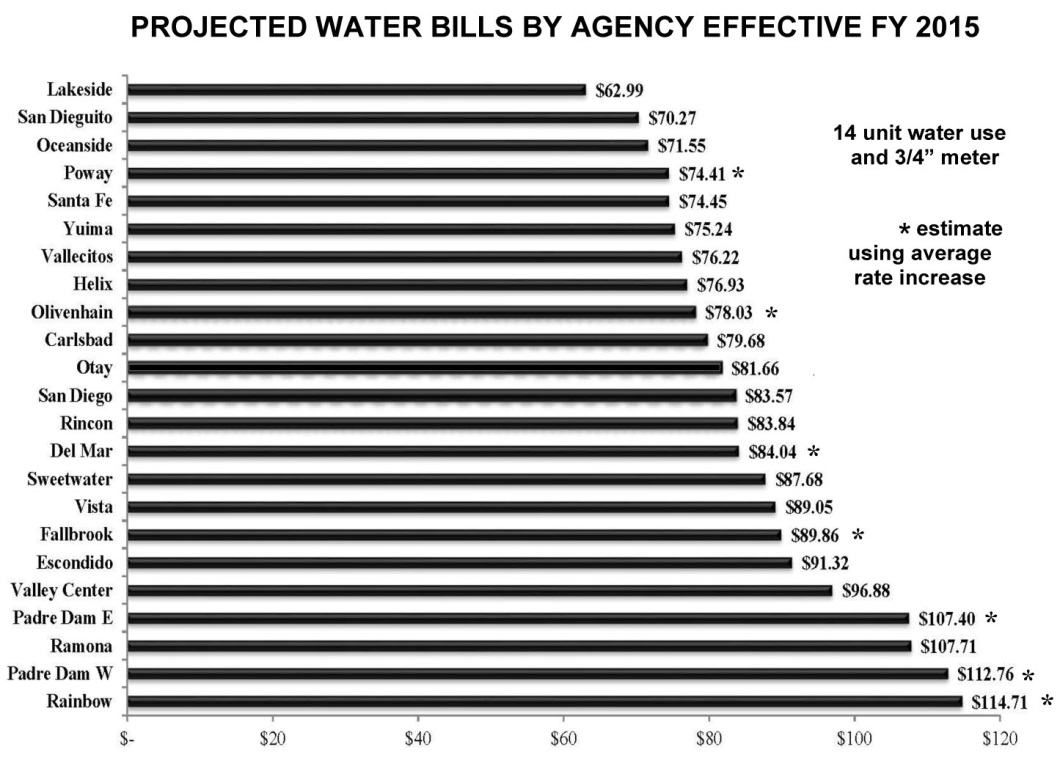
Looking at the bigger picture, there are 24 water agencies in San Diego County. Being that we essentially have one electrical utility, I think we can agree that 24 districts is far too many. If we can consolidate some of those agencies, there will be real savings achieved through the elimination of duplicate jobs, as well as increased economies of scale, just as Fallbrook and Rainbow experienced during their functional consolidation. That means lower water bills that would benefit the ratepayers of those districts, Rainbow in particular, with the highest water rates in the San Diego County.
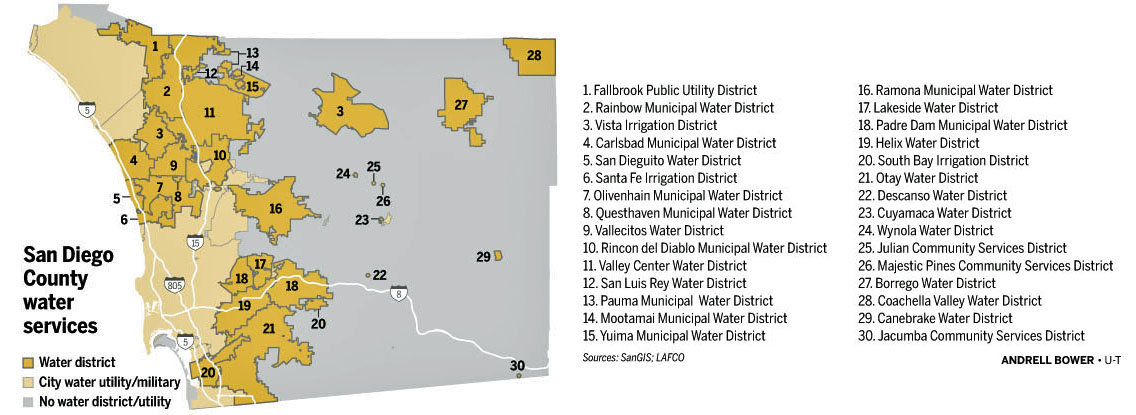
As well, when you consider water rates are rising far faster than the rate of inflation, the water bill takes a bigger bite than ever out of all our incomes. In addition, because water districts are monopolies, with no oversight agency, there really is no pressure to hold down costs or for that matter to consolidate.
I do have to note, when the Rainbow board first decided to look into consolidation it was a bold step. But shame on those same board members for putting their personal political ambitions in the way and backing out after it proved a success. And kudos to Fallbrook board members for pressing the issue with LAFCO, as it was the right thing to do for ratepayers.
To give an example of how a consolidation actually worked to the benefit of ratepayers in San Diego County, look to 2006 when Riverview Water District was merged into Lakeside Water District in East County. Riverview customers, who had high rates, now benefit from the lowest water rates in San Diego County, through Lakeside. Granted, Riverview customers voted for the consolidation, but they didn’t spend $150,000 on consultants and public relations experts like Rainbow did to fight the current merger attempt.
One of the other things Lakeside Water District does to be efficient is run itself more like private business. So, they might buy slightly used vehicles, hire part time people, and the like, but that is the kind of thinking we need from more public agencies.
What LAFCO is supposed to do is cut through the hype and make a recommendation based on thoughtful analysis. To the LAFCO staff’s credit, they did precisely that, spending 16 months studying the Fallbrook/Rainbow matter before making a recommendation to approve the consolidation.
Unfortunately, with Rainbow’s public relations machine getting people all up in arms, five elected officials sitting on the LAFCO board bowed to the pressure and made the wrong decision that did not benefit ratepayers.
I congratulate the three board members that did see through the smoke and mirrors and voted to go through with the consolidation. Those were Escondido Mayor Sam Abed, Olivenhain Municipal Water District President Ed Sprague and public representative Andy Vanderlaan.
Potentially, the worst thing about this aborted consolidation is it could easily set a barrier to future consolidations that are much needed throughout San Diego County.
I ask that the LAFCO Board reconvene and reconsider this important issue. But this time, forget the hype, stick to the facts and make a difficult decision (really not difficult at all), which benefits the ratepayers and paves the way for future consolidations.
***
Robak has served on the Otay Water District Board of Directors since 2005 and prior to that from 1996 to 2000 as Board Member of Padre Dam Municipal Water District. He believes in efficient government and not the protection of personal fiefdoms. Follow him on Twitter @OtayMark
Comments 10
Mr. Robak,
After reading your blog post I felt compelled to correct some of the inaccuracies and misrepresentations.
– The agricultural community of Rainbow MWD is very different than the more urban area of Fallbrook – we are one of the last water districts that has over 80% of our water going to agriculture. The issue of local control for our agricultural industry is critical – it is a matter of life or death for this industry. Water policies, and the control over those water policies, are critically important to agriculture, and the dilution of representation on a combined board was a significant concern. This decision was a pro-business decision.
– The projected savings that were pushed by FPUD and rubber- stamped by LAFCO staff were illusory. The savings they projected came from huge job cuts (40% of RMWD staff), which could not be sustained and would have resulted in significant reduction of services. RMWD is a very lean organization – I invite you to come up for a visit to see for yourself. Job cuts of this size would have resulted in massive maintenance deferrals followed by system failure. Reliable water supplies are critical for our agricultural industry – this is a business necessity.
– The projected savings claimed by FPUD, even in their most extreme, would not have lowered water rates. The proposal from FPUD asked our agricultural industry to give up representation on the board in exchange for nothing. The rate chart shown in your blog post was shown at the LAFCO hearing to be a bogus comparison. It compares customers who use 14 units per month, but our average our average customer uses just over 100 units per month. If you run that same analysis using 100 units per month, our flat rate system, which is pro-business, will show that our rates are not the highest in the County. This type of cherry picking of data is typical of the tools used by LAFCO staff to try to confuse the Commissioners – most of whom saw right through it.
– The local community was strongly opposed to the merger for a variety of reasons. Rainbow MWD asked LAFCO to simply make an election a condition of approval and we would not object. LAFCO refused to allow the ratepayers to have a say in the matter, twisting the statutes in order to prevent what is clearly allowed by law. The rights of the people who pay the bills to determine their form of government is the foundation of conservative principles, so to characterize the Commissioners who supported the rights of the voters as somehow outside of Republican principles missed the mark by a wide margin.
Rainbow MWD never said that mergers were bad in all cases. No Rainbow Board member is so enamored with their position that they would block a merger just to save a seat. The reality is that the conditions in this area were not conducive to a successful merger and the ratepayers made it clear where they were on the matter. As elected officials, it is our role to listen to our constituents and act in accordance with their wishes. If all you know about this situation is what you have read in the paper, you will get a distorted view of reality. I would be happy to sit down with you here in Rainbow and go over the real details so you can have a better understanding of why the majority vote of the Commission was the right decision.
Thank you
Dennis Sanford
President, Rainbow MWD Board of Directors
Interesting reply Dennis. But it didn’t really explain why your water rates are projected to be the highest in the San Diego area. Even if the projected rates are off, your prices still seem very high. Why?
If I was an agricultural user in your area, I’d be furious at your projected high water prices for 2015. This translates roughly into high crop costs and less profit.
Maybe a merger is not such a bad idea after all.
Dan,
Good question. Water rates are a combination of fixed fees and variable rates. I won’t get into every detail here, but our rate structure is designed to favor larger agricultural users, with a larger fixed component and lower, flat rates after that. As I indicated above, our average use is around 100 units and the variable price for the 100th unit is essentially the same as the first. Other agencies in this list charge more at increasing levels as you consume more because their water is used by residences, not businesses making a product (avocado for your guacamole is a big user). Other agencies in the list have low fixed rates but charge double or triple the variable cost the more you use. This sort of structure is very bad for agriculture because it inhibits their ability to create more products cost effectively.
So as you use more water, the fixed component of the charge becomes a smaller and smaller percentage of the total cost, while the variable stays the same. The inclining block rates of most other agencies would put our growers out of business. Comparing the rate structure designed for 100 units a month to one designed for 14 units a month misses the point.
We will be having a discussion on our water rates at our October 27th Board meeting. You are welcome to attend so that you can see exactly how the rate structure works.
Thanks
Dennis
President Sanford:
While I respect the fact that you have a different opinion of the rate analysis done by Fallbrook (FPUD), the savings to Rainbow (RMWD) customers are significant.
Acknowledging RMWD is an agricultural community, if you look at the “Special Agriculture Class” a FPUD special agricultural customer who uses 400 units per month (300,000 gallons) and has a 2 inch meter would save $3,520 per year when compared to the RMWD’s rates. At this consumption level, RMWD’s monthly bill is 20.3% higher. The comparison only included the standard pumping charge of RMWD. For those RMWD customers to whom the pumping zone surcharge applies, the FPUD’s savings are even greater for all consumption levels. For the special agricultural class the fixed charges for FPUD are lower than the RMWD fixed charges. There also is a constant 20% difference between the two agencies (with RMWD higher) for the water consumption rate for this customer class. In the smaller 1” and 1.5” meter sized the savings range from 10.5% to 19.7%.
See Graphic on Ag Customer Savings.
For most consumption levels tested, the FPUD monthly bills are lower than the RMWD monthly bills. In some months they are substantially below.
See Graphic on Domestic Customer Savings
Even if you don’t believe this analysis which was prepared by the respected Michael Bell Management Consulting, San Diego LAFCO staff reached similar conclusions. Their research shows the merging of the districts should save roughly $1.3 million annually at the outset and $2.3 million in future years with reduced administrative costs and resource sharing. As well, those savings would not be a result of layoffs of RMWD staff, as you assert, but by attrition.
On another note, and as you know, RMWD is under a Conservation Order by the California State Water Resources Control Board (SWRCB). http://bit.ly/1NKKjHI You are only one of eight agencies in the state under such an order and the only one in San Diego County. Because of this order, my understanding is you have been mandated to hire people and raise rates, in addition to other requirements. If you don’t, failure to do so could equate to fines and other sanctions from SWRCB.
So again, I understand you had a change of heart when the reality hit that your Board might lose some of its members with the consolidation, but that IS NOT in the best interest of your ratepayers. And it is not a good business decision.
Mark Robak
This may be the best argument to liberate the water industry from government control
I was in the process of contacting Andy Hollingsworth, an ex-member of the SD City Water Board, to respond to the water pricing issue when Mark Robak made his comments. Thoughtful and well-articulated answers Mark.
The pricing answer of Dennis puts me in mind of my times in Silicon Valley. As a veteran Silicon Valley executive, I would be in meetings where some of my software product managers would attempt to baffle me with BS about their new product specs and functionality since I did not have an engineering background. I would answer them in the only way that mattered. I’d ask, “When you did Beta development with my key customers, is this what they wanted?” To which they would usually reply, “This is what the USB committee specified as the key functionality and features”. In other words, like I think Dennis is doing to his agricultural customers, they ignored what the customer wanted and tried to force their view of the world on the customer. This always ends up badly.
Dennis, don’t be “that guy”. Be very customer oriented. Find out how you can help your agricultural customers and implement things that benefit them and help their business. Like reduced prices. Business is tough enough in California. Help them out and you’ll earn their gratitude and support.
After looking at the chart for projected water bills a better question might be why are Padre Dam water rates so high. Doesn’t help the “economies of scale argument much. I don’t any of the behind-the-scene stories here but the appearance is that the merger was not favored by Rainbow. You can put what ever political spin you want on it but until that debate is answered then the LAFCO vote was a proper one. Given the voiced opposition and the lack of a public vote or referendum I probably would have voted against it as well.
When it comes to local control, price has nothing to do with it. If the constituents of that district want control of their water and are willing to pay for it in higher prices then that is their choice. There are some real differences in interests between the two districts that are very important. If elections were going to be at large I can see where Rainbow would have major concerns with loosing a voice concerning water. Water is life for everyone but even more so in an agrarian community like Rainbow. Just because they don’t agree with your model of efficiency doesn’t mean their concerns aren’t legitimate Mark.
Public or private, water issues are a community concern and will have to represent the interests of any given community. Tomato/tomato it all comes down a community having a proper voice in their interests.
“it all comes down a community having a proper voice in their interests.”
Is there any better example of that than the Apple community? How about the Dollar Shave Club community? Or the BMW community? Or the Chik-fil-A community? Or the Ballast Point beer community
I don’t know any water consumer who purchases clothes with the Water Board’s logo on it but they do for the aforementioned private brands.
I’m not being a noodge here– can we get ONE elected water board official, Republican or Democrat, who would propose the idea of doing away with the Water Board?
And who would you propose take on the interests of the community? Things like this don’t run themselves. Flawed as it may be there is a place for elected boards. Keeping them true to their fiduciary responsibilities is the function of the election process and the voters. If a public monopoly is left to private enterprise the motive is profit and not necessarily in the public’s interest. Of course they are usually governed by the CPUC and we’ve seen how that’s working for us.
“And who would you propose take on the interests of the community? ”
Those who would profit from meeting those interests, the same way Apple, BMW, Chik-fil-A, and Ballast Point does. Profit IS congruent with the public’s interests because it self-regulates, yearly, quarterly, monthly, weekly, daily, and hourly.
Who knows more about the market for clean water in Santee? A board of five planners or the tens of thousands of consumers who vote hourly with their pocketbooks?
Capitalists have done a much better job at providing life-sustaining resources to the community than central planners do.
Wouldn’t it be great if Rainbow, Padre Dam, and the many new water companies competed against one another for your money?