

Recent testing of San Diego fourth and eighth graders showed that the poor kids are doing even less well in San Diego’s schools than when similar tests were conducted in 2003. From the U-T.
Among San Diego’s fourth-graders eligible for free lunch, those tested last year earned a math score that was 38 points lower than those who do not receive that income-based subsidy. That’s a deeper chasm than the 27-point difference reported in 2003.
Budget cuts are blamed by some in the article for the drop in scores, but the gap is consistent with other research.
In his 2008 book, the Outliers, Malcolm Gladwell posits that the reason for lower test scores achieved by lower income students was due to lack of summer activities that promote further development of reading skills. From the book, he addresses research performed by Johns Hopkins University sociologist Karl Alexander. He reviewed changes in reading test scores that occurred over summer vacation, dividing scores by income groups, top, middle and bottom.
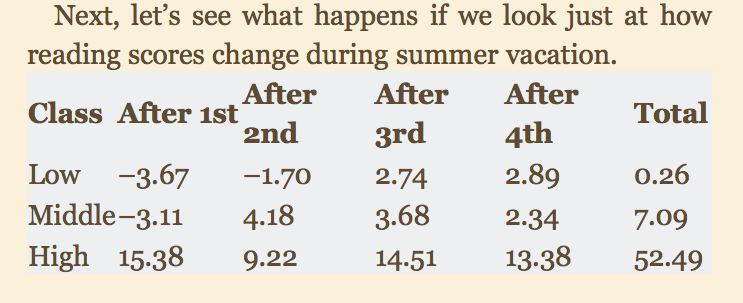
(Source: Gladwell, Malcolm (2008-10-29). Outliers: The Story of Success (p. 257). Hachette Book Group. Kindle Edition.) We see that the those in the high income group achieve a 52 point cumulative increase in test scores over their summer vacations, compared to poor children, who make no progress.
In Outliers, Gladwell looks at KIPP (Knowledge is Power Program) where students spend considerably more time in school than the national average. The program has lifted almost everyone one of its poor students into college eligibility. From The Economist:
In particular, charter schools in the Knowledge is Power Programme (KIPP) start the school day at 7.30am and end at 5pm, hold classes on some Saturdays and teach for a couple of weeks in the summer. All in all, KIPP students get about 60% more class time than their peers and routinely score better in tests.
The lengthy school days, and the work over the summer allow these poorer children to perform as well as students in wealthy districts. One of the criticisms of the KIPP program is the self-selection of children whose parents are motivated to be involved. However, I see it differently. They have a program that demands high commitment from parents, and being free from the shackles of the public education system, they can do so. It is just one of many innovations available when schools are freed from tight legal restrictions.
A public school cannot compel the compliance of parents to be involved in their child’s education in the manner that a charter such as KIPP can. When government takes over the duty of educating all children, we lose the flexibility to allow education to innovate to 21st century demands. Further, the schools no longer view parents as clients they must please in order to maintain their business of educating children. For this reason, I believe we should end the system of public education and provide subsidies to allow parents to pay for the education of their children.
Will that fix the system? Probably not, because parental involvement and longer hours are also needed and full privatization won’t fix that. However, as schools who implement reforms that draw the parents into greater involvement and longer hours, including summer studies for students, their free market success will spawn imitators.
Comments 26
Sadly, most parents don’t understand the importance of their role in their children’s education/success. Change that and the rest will fall into place.
Give the parents a stake and some say in their kids’ education. Switch to education vouchers or tax credits to pay most (hopefully not all) of the kids’ private school education.
Why not pay all? Because then the parents have no skin in the game – at least financially.
But I’m not picky. Pay it all if we must — it’s still half the per student cost of government education.
And the only debate is whether the result of private schooling is better than or “only” equal to pubic education.
Mom,
You hit the nail square on the head. My kids attend school in the one of the best public school districts in the state. Why is it so good? Because the parents are involved. I have never once been to my child’s classroom without seeing at least one parent volunteer helping the teacher. I also have not attended a single school play or band recital where the multi-purpose room wasn’t packed.
I know, and my children know, that education is the number one priority in our house and this is the case throughout the district. That is what makes for a successful school district.
Richard,
The problem is that as soon as the government starts paying for private schools there will be an immediate need for many more private schools. With the lure of free government money and presumably little or no oversight, many of these schools will not be anywhere close to “better or ‘only’ equal to public education.”
Yeah, Alger just like what happened to the colleges after the GI Bill was passed.
Oh, wait . . . .
JERRY COLEMAN: … “OK… Dick Rider, the Padres
dangerous Righty is up now, with the Bat he calls
‘History.’ … Alger into the windup… he deals a crafty
curve ball……… Dick Rider swings and connects!….
Back, Back, Back, Back,Back, Back, and that Ball is.,
Outta Here! Ohhhhhhh Doctor, you can hang a star
on that baby ! “
Poor public school poor kids. The hurrier they go the behinder they get. Give them freedom with vouchers to be spent at what ever school their parents choose. Then let the competition begin!
Richard,
What percentage of the public was eligible to go to college on the GI bill and compare that to the 100% that you are proposing be eligible to use government funds to go to private elementary and secondary schools. Oh yeah, and the GI bill was and is also used to help pay for public college, since unlike elementary and secondary schools, they aren’t free.
More like Jerry Coleman’s famous malaprop, “Back, back back, oh grabbed by the second baseman.”
Here is concept. Ease overcrowding and school operating costs by giving unemployed parents tax incentives to home school their kids. Pitch this to the Dems as within the spirit of FDR’s new deal.
Come on, Alger. I expect more from you.
Millions of veterans returned from the war and used the GI Bill. Cassandra predictions such as yours failed to materialize.
You’re a bright guy. How would you (spoiler) PHASE IN school vouchers so as to not overwhelm private schools? Three to five years, perhaps? I don’t have a problem with that. Do you? What must be certain is a phase-in SCHEDULE to provide the certainty for private school operators to plan ahead.
Let me give some answers to other upcoming questions Alger would doubtless pose if and as he thought of them:
1. Where will the private schools get all the qualified and experienced teachers? ANSWER: Oddly enough, under this option, a lot of ex-government school teachers would be looking for a job. And UNLIKE the public schools, the private schools could hire and RETAIN and REWARD teachers based on excellence and results.
2. Do we have to close the public schools? ANSWER: While that is MY preference, I have no problem as leaving the public school option open for all. Democrats’ kids deserve an education too, and Dem parents don’t care about their kids as much as the rest of us do our own — so sadly they will too often opt to continue their kids in the government school indoctrination program — larded up with syrupy self esteem. To each his own.
3. Where would all these new schools be built? ANSWER: Many private schools would take over abandoned public school campuses, either by purchase or lease — as is done NOW in the SDUSD.
4. Has this ever worked? ANSWER: A number of European countries (most, as I understand it) offer voucher programs to varying degrees. Oddly enough, Sweden has had a full voucher option for decades, and one gives it a second thought.
In the U.S., voucher programs are ALWAYS popular with parents, but they have been limited to too small a subset of the kids, or overturned by labor-friendly courts. Several are in operation around the country now.
BOTTOM LINE: Kids in private school do as well or better than those in public school, and they do so at less than half the per student cost of public schools. Parents like it, kids like it, but the teacher unions do not. Guess who holds sway in the legislative bodies of America?
Richard,
Almost 8 million veterans of WWII used their GI Bill. Many used it for private college tuition, but many more used it for public college tuition or to learn a trade (mostly in union programs).
Again I ask you to compare that 8 million number, most of whom did not go to a private college, with the number of school-age children we have in this country.
Two other questions since you are the economic genius. When the government starts paying private school tuition, will the cost of that tuition go up or down? Has the cost of a college education gone up or down?
Finally, let’s see if you can respond without personal insults or stupid comments like “Dem parents don’t care about their kids as much as the rest of us do our own.” They really do cheapen your arguments.
Alger, the Democrats’ desire to steal from the rich and give to political allies is bad enough, but when they sacrifice the future of low income, primarily minority children to the public employee labor unions who hold the party purse strings, that is absolutely unforgivable. Simply stated, care more about education union support than the education of kids.
Apparently you are okay with that. Most Democrats are. Nothing personal about the insult. I’m including millions in this condemnation, though admittedly I’m angry mostly the Democrat apologist activists and policy makers. You are one, if not both.
I joke about a lot of things. but this “keep minority kids on the Democrat Party plantation” policy by banning superior school choice is reprehensible. Shame on you!
Alger, your man Obama and his Democrat handlers tried to kill off the tiny DC private school voucher program, a program where so many low income people want to use it for their kids that selection is done by lottery.
The black grassroots outrage at the elimination of the program was so embarrassing for the Democrat Party that they wisely backed down. As an apologist for Obama, I presume you supported that attack on vouchers, though not publicly.
You make one valid point, Alger. Increasing money for private education WILL increase the price of such education. But the current average price is less than half of inadequate public education — a cost that has risen FAR faster than inflation. In essence, BOTH would continue to rise, though competition in the private sector would have a dampening effect above the value of the voucher.
At the end of the day, the cost to taxpayers is STILL cut in half, and better education results.
Richard,
Two closing points:
1. Competition has not kept the cost of a private (or public) college education from rising much faster than the cost of inflation.
2. It is difficult to have a conversation with you because, like most politicians, you completely ignore half of the conversation and are intent in making your points rather than responding to what is being said to you.
Alger, did you not ignore my point about PHASING IN vouchers? Did you not ignore my agreeing to leaving the public schools open for uncaring parents? Did you not ignore Sweden which has a full voucher system and it’s running fine? Did you not ignore the considerable savings available for a superior product? Who is ignoring whom?
You present NO argument opposing the concept of school choice.
Cannot you be honest and just come out and ADMIT that you oppose parental school choice and saving the education of our kids — admitting that your primary concern is the welfare of public education employees?
Here’s a thought — if I were the Grand Poobah of the KKK, I’d agree with Alger. NOTHING has done more to “keep blacks in their place” than public education — especially the disaster that is the modern urban monopoly school district. Like Alger, the KKK does NOT want such kids to have the option of a better, private education.
Another point for Alger. The private school option doubtless would improve PUBLIC schools. I did in Florida. If a public school got a failing grade for two years in a row, the parents were given the option of using vouchers to attend other schools, including private schools.
Schools that failed the first year went into crisis mode to improve their product. The teachers shaped up, tutoring was instituted (with volunteers and existing funding), Saturday remedial classes were started — and the kid’s test scores rose at a remarkable rate.
Even Alger understands that competition provides a better product than a monopoly.
On second thought, in Alger’s case, it would be unwise to make such a presumption.
Alger, since you oppose school vouchers because they would drive the price of education up, then surely you are opposed to putting 46 million people on “Food Stamps” — vouchers for food. Right?
Richard, Richard, Richard,
You do love to do two things:
1. Compare apples and oranges: Sweden has less than 10 million residents; the U.S. has more than 300 million.
2. Assume other people’s beliefs: I never once said I was opposed to school vouchers. In fact, in the case of schools that are failing, I think giving the parents another option is not only a good idea, it is a necessary one.
Where we differ is that I don’t believe in “throwing the baby out with the bathwater.” Public education still is and hopefully always will be the great socioeconomic equalizer. It is the reason that a janitor’s child can grow up to be a CEO. I am not saying we shouldn’t do what we can to make it better, but I certainly don’t think that making school vouchers available on a universal scale is the answer.
You write about how competition will make the public schools better, and to a point, you are correct. Monopolies are almost always a bad idea, but the public schools really aren’t a monopoly. Parents already have a choice to send their children to private schools and many will provide scholarships to those with economic need. Parents generally also have the choice to send their children to a different public school than the one in their neighborhood or even move to a different neighborhood if the school district is better.
You write about how competition will keep the cost of a private education down and here you are dead wrong. There is quite a bit of competition in the post-secondary school market, yet costs are rising at a rate far above that of inflation. The problem, as you know, is that colleges and universities are not worried about the price they charge, because their customers are generally not the ones paying.
If we provide universal vouchers for primary and secondary education, you will see the same meteoric rise in cost. When the poor can no longer afford the difference in cost between a voucher and tuition, school choice will be based on ability to pay and that janitor’s kid is going to grow up to be a janitor or worse, a criminal.
I don’t want to ignore your magnanimous offer to keep the public school system. Unfortunately, your plan will still destroy it. Universal public education works precisely because it is universal; everyone is given the same OPPORTUNITY at success.
The bottom line is that I know the public education system has its problems and we need to make changes. The bureaucracy needs too be shrunk, local schools need more autonomy to do what’s best for their students, we have to find a way to encourage parents to be more involved and care more about their children’s education and yes, teachers and administrators need to constantly be reminded that the number one priority is the children, not their personal comfort.
However, none of that means we need to eliminate or negatively impact public education. It is one of the great social institutions that has made America great and we should do everything we can to build it up, not tear it down.
Alger, Alger, Alger
What difference does the size of Sweden have to do with vouchers? By that metric, than I guess it’s all but impossible to envision monopoly public school systems in a country of 300 million. Really?
France has a voucher option. Are they big enough to satisfy you? Naahhh. So does Chile.
OF COURSE you didn’t SAY you were opposed to vouchers, Alger. As a spokesperson for the labor unions, you’re far too clever for admit that. But you ARE opposed to vouchers.
You cobble together an exception or two where you say vouchers are okay — to try to sound reasonable (and fail miserably at the effort), but fundamentally you don’t want to give parents that choice.
What rationale do you use to mandate that parents have to wait until government declares that government schools are failing before the voucher option is made available (and damage has been done to the kids by putting them behind)? Should not it be the PARENTS (and not the government) who make that determination?
You falsely claim that it’s public schools that allow and prepare the poor for upward mobility. No, it’s the FREE EDUCATION that does that. Just because the taxpayer is tasked with that obligation (fairly or not), it does not follow that only government can and should PROVIDE that taxpayer-paid service.
If that made sense, we would not give out Food Stamps — we’d set up government grocery stores as the only places where the needy could acquire free food. Or we’d not have housing vouchers as an alternative to building wildly overpriced government funded “affordable housing” (another voucher doubtless you oppose). Or we’d offer only government day care centers, as opposed to providing tax credits to help parents use PRIVATE day care (another area you’d doubtless love for government to take over).
Alger, you tip your hand when you talk about public schools being a “great social institution.” A MAJOR “advantage” of public schools (from your perspective) is that you get to, ahem, “socialize” the students.
I’ve seen the results. Over 30 years I’ve spoken to scores of high school civics and economics classes at about three dozen public and private high schools in the county. Of all the groups I speak to, the toughest, most socialist group is public high school seniors.
For 12 (or more) years, they’e been in government schools, taught by government teachers, using government approved textbooks, and largely isolated from alternative perspectives. Then for maybe 45 minutes they heard (from me) the limited government perspective, an alien concept they knew nothing about. Perhaps 98% of the public school seniors don’t get even that much exposure.
Is that single, pro-government agenda considered “education”? Well, in the “education camp” sort of way (as you like it).
Environmentalism is taught as religion rather than a science, and no dissent is allowed. The only time a divergent viewpoint on that — or concerning economics or politics — is brought up is when a teacher wants to make fun of it — presenting warped and skewed caricatures of the conservative and libertarian viewpoints.
So I fully understand why (aside from your labor union fealty) you are so enamored with government schools — like Otto von Bismarck, who first pushed hard for a government school system, liberals grasp the advantages of controlling the “education” of our young. Which, of course, is another reason I want education CHOICE.
Alger, you REALLY want to pretend that the lower income folks have a private school option? Okay, if you can live with yourself. Ask the poor tell you otherwise — that such an option takes TREMENDOUS sacrifice, and likely is outside their funding capabilities.
Some schools provide limited scholarships to limited numbers of students, but those scholarships are hard to get — the demand is FAR larger than the supply.
Moreover, if parents chose that option, they would be saving the taxpayers the cost of public schooling. Is it not fair to give them (via a voucher or tax credit) some of that savings to ease the burden of private schooling? Don’t bother to answer — we KNOW your answer.
Alger, if we provided a $15,000 voucher, doubtless the schools would charge that much or more. But the voucher being discussed is in the $4K to $8K range. Above that amount, the competitive pressures kick in. Not to say that prices would not rise above that voucher floor, but the increase would not be anywhere near the bogeyman levels you like to suggest.
Given that we are now spending over $12K per student for public education (and that is understated), we’d save a boodle. But even if the private tuition price rose to public school levels, we’d still be getting as good and usually a better product than the public schools provide on average.
And don’t forget — the taxpayer would be paying only $4K to $8K per private school student. WITH NO UNFUNDED PENSION AND/OR RETIREE HEALTHCARE LIABILITIES.
Not that you care, of course.
Alger says:
“The bottom line is that I know the public education system has its problems and we need to make changes. The bureaucracy needs too be shrunk, local schools need more autonomy to do what’s best for their students, we have to find a way to encourage parents to be more involved and care more about their children’s education and yes, teachers and administrators need to constantly be reminded that the number one priority is the children, not their personal comfort.”
Alger, your solutions are empty rhetoric. These are platitudes that defy reality — hoping that people nationwide will somehow change their behavior and forego self interest.
I might add that allies on my side are sometimes just a guilty of mouthing the same “solutions” — which will NEVER happen. But, unlike my naive friends, I suspect you KNOW they will never happen, but absolve yourself and your union friends of responsibility by MOUTHING such platitudes. Works for you!
Richard,
You have no idea what I care about and certainly have no clue about who I speak for (Hint: it starts with an “m” and ends with an “e”).
I do find it interesting that you and many like you love to wave the flag and talk about American Exceptionalism, but at the same time, want to tear down the institutions that made us great in the first place.
As for why high school seniors are the “most socialist” group you have ever dealt with, I wouldn’t blame the schools for the that; our youth has always been the most idealistic and it is not until they have to deal with the real world and more exposure to naysayers like yourself, that they become more cynical, selfish and conservative.
I grow tired of this parallel discussion we are having. It is similar to two two toddler who appear to be playing with each other but are really only playing in the same room. I will let you have the last (or thousands of) word, but just to show I do read what you write, let me address the issue of food stamps and the cost of food:
Of course the food stamps program adds an incremental cost to the food we buy, but before you eliminate this program, realize that if you really wanted to lower the cost of food, the best way to do that would be to change the location of the first Presidential Caucus.
Richard,
I didn’t know you were still responding.
“I suspect you KNOW they will never happen.”
Did YOU also knew that the top income tax rate would never go below 80%? Did you know that a President named Clinton could never work with a Speaker named Gingrich to reform the welfare system? How about our local school district; did you know that they would never agree to give a proportional share of bond money to Charter Schools?
It is amazing how many things that “will never happen” actually happen when people work to make them happen instead of playing the martyr and taking the defeatist attitude you love to espouse.