

When the precincts returns came trickling in on Election Day, the Yes on Proposition D campaign couldn’t have been happier. The panicky predictions heard in the rumor mill about its chances of success turned out to be dead wrong. At the time of this blog post, the San Diego Registrar of Voters counted 60.53% of San Diego City voters in favor of its passage, a smashing victory by any measure.
Loud supportive arguments made by proponents focused mostly on government accountability and taxpayer savings, but little mention was made of its potential to empower San Diego’s growing Asian & Pacific Islander community. Proposition D requires the City of San Diego to add a ninth council district, to be drawn up during the next redistricting process. New data from the 2010 U.S. Census canvass would be used to identify the growing neighborhoods in SD, and in 2011, selected citizen participants would attempt to redraw City Council district lines in a balanced and equitable way, and in adherence with federal Voting Rights regulations. It is my sincere hope that we will have a fairer process next year, one that makes amends for the adversity API leaders faced the last time around.
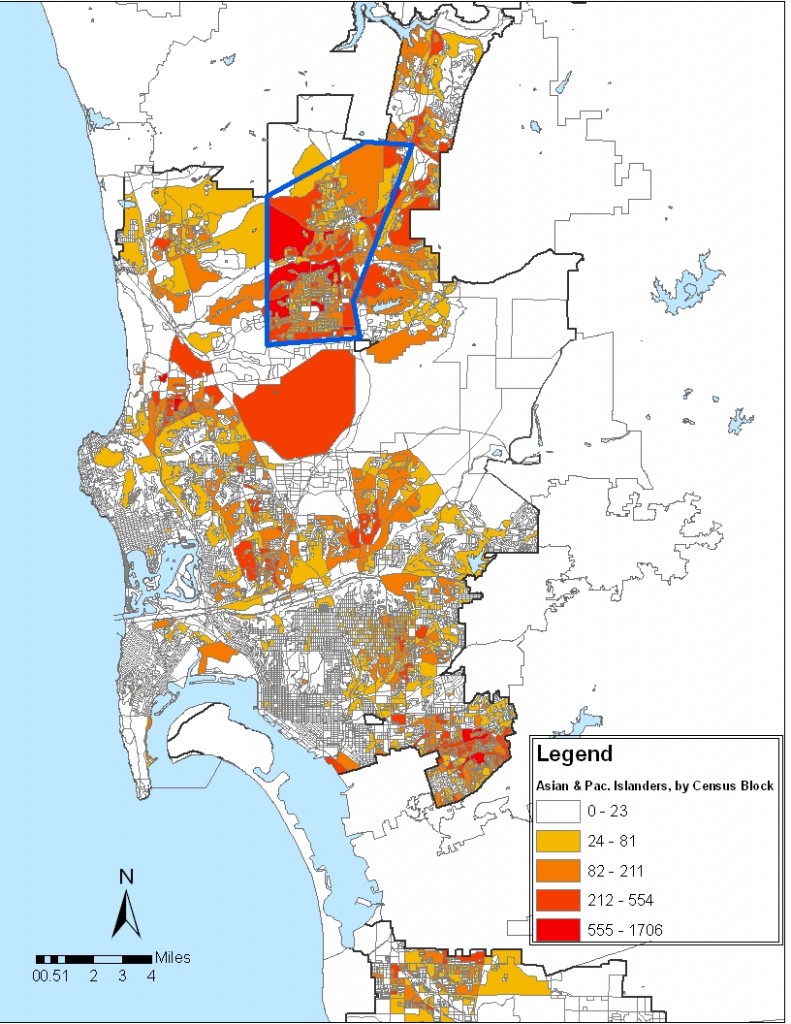
The last redistricting effort by the City of San Diego arguably disenfranchised the API community, by bisecting the congruent, and predominantly Asian communities of Mira Mesa and Rancho Penasquitos. The map above is a GIS map of 2000 Census data, showing where the API community is concentrated, with the two neighborhoods outlined together in bright blue. A broad coalition of Asian community leaders proposed uniting these neighborhoods under one City Council District to the Redistricting Commission, but their efforts were senselessly rejected. This mishap is chronicled in the San Diego Union-Tribune’s archives, which can be found in this article and this article.
Since 2001, Mira Mesa and Rancho Penasquitos have grown in not only population size, but also diversity. Ditto for the North University City community surrounding UCSD, and Carmel Valley, both communities with significant API populations. SANDAG’s population estimates show that a new Council District would likely come anyway from the northern, I-15 neighborhoods, which have ballooned in size, and have pushed Council Districts 1 & 5 to become the largest among all eight Districts. But it’s not clear that the fortunes of the Asian & Pacific Islander community will be any different next year, which is why API leaders are now preparing to have their voices heard loud and clear at City Hall. A background of what’s at stake was featured in a story by 10 News last week.
As the old saying goes, “power isn’t given, it’s taken.” San Diego’s API community will have to fight to be recognized in the next round of redistricting, which unofficially begins July 1st, the first day applications will be accepted for the new Redistricting Commission. More to report on this in the coming months.
Political injustice and disenfranchisement, even if they’re unintentional, hurts not only minorities but the foundation of our democracy, and our right to be represented in the political process. With the passage of Proposition D now secure, I’m proud to join Asian & Pacific Island leaders in saying: not again. Not this time.
Comments 2
Very thoughtful post, Vince, and something all of us in the current Districts 1 and 5 need to keep our eye on whether you’re part of the API community or not. Redrawing these districts will be a critically important decision. I’m in Scripps Ranch and I wouldn’t mind one bit seeing districts divided by I-15, with those on the east side of the freeway in one district and those on the west side of the freeway in another. This would keep the API population contiguous to boot.
BUT people with an interest in holding office won’t easily yield the affluent neighborhoods of Scripps Ranch, Rancho Bernardo, and Carmel Valley/Torrey Highlands/4S Ranch. Folks in these zip codes donate money to candidates and they vote. Mira Mesa, PQ, and UC, not so much. That’s where the problem lies for the API community. It would be a worthwhile exercise to study campaign donations by zip code and see if my impression is correct.
Author
Hi Gayle! Thank you for you kind words and your thoughts. I think you’re right – it would be a fight to wrest these neighborhoods from D1 and D5. Carmel Valley may be out of the question, and Dems may be more willing to give up PQ, which is strong GOP territory and one of the few solid areas that supported Thalheimer in 2008. It should be interesting to watch what happens…