

This Is Why We Can’t Have Nice Things: Heavy-Handed State Interference in Land Use Fomenting a Revolt
The fight to keep local growth and planning decisions in local hands is no longer theoretical.
Lots of talk in California about the billionaire’s tax, insurance rates, AI, and high-speed rail, but as the State takes an increasingly active role in local land use issues, the sleeper issue in the Golden State may be local control. Thankfully, relief in the form of a ballot initiative enshrining the ability of local councils to control their cities’ destinies is in the works.
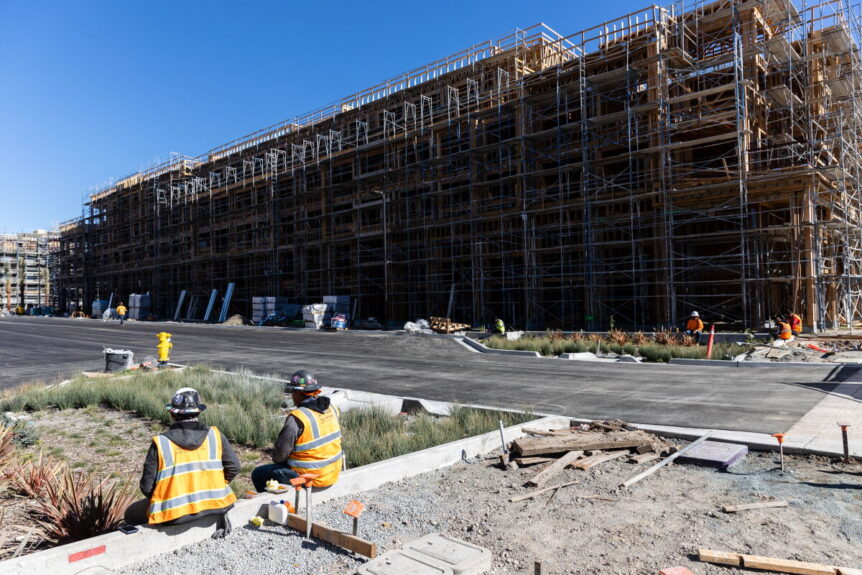
Go to almost any decent-sized city in the state and you will notice the proliferation of condos.
On every empty lot (no matter how irregular the size and shape); along rail corridors and in residential neighborhoods; in open fields and urban centers: Condos! Condos! Condos!
In many cases, those condos (or apartments or “housing units”) are being built over the objections of the very cities in which they are located. And there are more to come, even if the cities are (or at least consider themselves to be) “built out.”
Take for instance Del Mar. Longtime North County coastal residents are probably familiar with a large, empty lot just north of Dog Beach, appropriately enough called the North Bluff. Just across from the Brigantine, within walking distance to the Belly Up in Solana Beach, overlooking both the Del Mar Fairgrounds/racetrack and the Pacific Ocean, this is what is called Prime Real Estate.
For two decades, the future of the lot has been the subject of a fight between the city and its owner. An attempt to build a resort was rejected by voters in 2020. Two years later, the owner counterpunched with a proposal for a residential development with 259 units, 85 of which are to be designated affordable, including 42 for low- to extremely low-income households. Take that!
Since then, the battle over North Bluff has centered around a number of complex legal arguments regarding the status of the city’s so-called Housing Element (a codicil required under the city’s General Plan), the interpretation of state laws regarding affordable housing, and the city’s zoning rules.
In 2024, the city entered into an agreement with the 22nd District Agricultural Association, which owns and operates the Fairgrounds at Del Mar (and which are actually within San Diego city limits), to explore the possibility of building up to 61 affordable housing units where the “Turf meets the Surf.” Those notional units would count towards Del Mar’s mandated allocation (more on that below). Alas, the effort, which from appearances was never really serious to begin with and was complicated by the issue of building a rail tunnel under the facility (an effort Del Mar supported), fell apart in August.
All of this is playing out against state mandates for housing as detailed in SANDAG’s 2020 Regional Housing Needs Assessment (RHNA) Plan (6th Cycle), which in conjunction with the State Department of Housing and Community Development (HCD), allocates to the County and each city in it the number of housing units it should “accommodate” as part of its Housing Element (along with any necessary changes to its General Plans and zoning laws). Under that plan, Del Mar is responsible for 175 new units by 2029, including 13 carried over from the previous cycle. According to the city of Del Mar, as of August 2026 it has met its current RHNA target by approving 188 new units, including 50 units that are currently under construction, 10 of which are low-income. According to SANDAG, the seventh cycle RHNA for the San Diego region will begin in 2031 and be effective through 2039.
The RHNA is one of those masterworks of government planning that sets for the region a litany of high-minded goals that are at once critical to the salvation of the world but which simultaneously make those goals impossible to achieve.
To wit: “…sustainability that focuses housing and job growth in urban areas where there is existing and planned transportation infrastructure, protects the environment and helps ensure the success of smart growth land use policies by preserving sensitive habitat and open space, and addresses the housing needs of all economic segments of the population.”
The RHNA is also meant to advance other objectives of state law to promote infill development, reduce greenhouse gas emissions, and “…provide a more equitable distribution of housing units that furthers fair housing and overcomes patterns of discrimination.”
In other words, another grab bag of good intentions that make it nearly impossible to build housing except in places no one wants it. And even then, it’s not the housing people want (single family homes)[1] but the housing the planners have decided is best for them–condos.
This Stalinist-like approach to housing planning is being led by two of the State’s most, well, Stalinist-like powerbrokers. State Senator (and current candidate to replace Nancy Pelosi in Congress) Scott Weiner won passage for a couple of bills in the late teens that put pressure on cities to “build” more housing (of course cities can do no such thing, but never mind that). In particular SB 828, expanded the ability of HCD to use the pre-existing RHNA process to dramatically increase housing goals.[2] According to the Embarcadero Institute, non-profit organization that publishes analysis that gives context to local policy, HCD’s aggressive stance, which included a change in the methodology used to determine housing needs, resulted in double counts that inflated San Diego County’s Sixth Cycle target by nearly 60,000 units.
Then there’s Attorney General Rob Bonta. As far back as 2021, Bonta formed a Housing Stike Force to, among other goals, “advance housing access, affordability, and equity across California…[and] the fundamental right to housing” and, using an “intersectional approach,” issue guidance letters to local governments on state housing laws.
In fact, Bonta sent one of those “guidance” letters to Del Mar late last year regarding the development of the North Bluff property. Despite having successfully argued in court that the developer’s suit was premature, Bonta scolded the city for having engaged in conduct having the appearance of a “deliberate attempt to avoid an adjudication” of the matter and threatened “potential penalties” under a law (AB 712) that was not yet in force.
Likewise, in that same year, Governor Newsom created the Housing Accountability Unit at the California Department of Housing and Community Development to “to assist cities and counties in fulfilling their legal responsibilities to plan for and permit their fair share of housing and to hold accountable those who fail to do so” (emphasis added). I guess he means “assist” in the same way a mugger assists his victim find his wallet.
And it’s not just Del Mar. Encinitas, Coronado, Solana Beach, Huntington Beach and others have all been targeted by the State.
In fact, it was under similar threat of litigation that in 2022 Encinitas was forced to approve a 250 unit project in a semi-rural part of the city on a property that is arguably totally inappropriate based on its configuration and location.
Neither is this limited to coastal “enclaves.” Elsewhere in the state, cities far removed from the coastline, such as Elk Grove (Sacramento County) La Cañada Flintridge (Los Angeles County), and Portola Valley (San Mateo County) have had their run-ins with the AG.
Into this morass steps Our Neighborhood Voices (ONV), a non-profit organization that is in the midst of a campaign to raise funds and gather signatures for a ballot initiative that will amend the state constitution to give cities and counties—and more importantly, the residents therein—the authority to override state laws impinging on land use planning and zoning laws. The cities of Del Mar and Encinitas endorsed the initiative in 2025. Oceanside and San Marcos have also signed on to the effort.
According to Nils Nehrenheim, President of ONV, the group estimates it will cost about $10 million to collect the roughly 1.3 million signatures it will need to qualify the amendment for the ballot. It hopes to offset at least some of that expense through volunteers. Any money it has raised so far as gone toward education and building coalitions.
To that end, at its 2026 annual conference just last week, the League of California Cities approved a resolution that directs the League to “support the development of a legislative or policy or ballot-based strategy to restore and strengthen local authority over housing and land use matters within municipal boundaries.” That’s a little short of a full endorsement of an amendment, which would obviate the continued threat of legislative meddling and endless litigation, but it’s something. Our Neighborhood Voices’ goal is to get an amendment qualified for the 2028 election cycle.
And the defenders of local control are going to need all the help they can get because opposition to local control runs deep—even at the local level.
For instance, when interviewed by the Voice of San Diego last year, State Senator, and former mayor of Encinitas, Catherine Blakespear stated that large problems are “bigger than any one city, and they need solutions that are bigger than any one city,” thus justifying state and even federal involvement. One might then ask why not the United Nations as well?
The same article indirectly quotes Blakespear as making the observation that some cities may want more housing, which could just as easily be an argument against heavy-handed involvement by the State. In fact, as far as I can tell, that’s the essence of the local control argument: some municipalities will want more housing (or industry or box stores or car dealerships) and some will not. Given the fact that decisions regarding such things have historically been left to cities and counties, the state’s intervention seems even more unjustifiable.
And let’s be honest, there’s more than a fair amount of class envy going on here. To quote Sonja Trauss, the executive director of YIMBY Law, an organization created to counteract the so-called “Not In My Back Yard” (NIMBY) resistance to new housing:
“A lot of these projects are being proposed in exclusive high-cost places – places where desire to live and desire to build is really high, but the cities have really strict laws. Finally, there’s a little bit of a crack in the glass where we’ll be getting some projects that we otherwise never would have been able to tap into.”
I’m sorry, but no one has the right to “tap into” their preferred neighborhood. And it is telling that Bonta includes the median house price in his various communications. For instance, noting in one of his guidance letters that in Encinitas “the median home price is $1.67 million, more than double the median price statewide.” It’s almost as if the State wants to punish communities like Encinitas because their residents have earned the right to live in nice places—and would like to keep them that way.
The fight to keep local growth and planning decisions in local hands is no longer theoretical. As Bruce Ehlers, the current mayor of Encinitas observed, developments proposed years, even decades, ago are now getting built.
“Where it wasn’t real and on the ground before, it is now, so that’s what’s changing,” Ehlers told the Voice of San Diego last year.
Now the question is if a state initiative can turn the tide before it’s too late.
_____
Steve Gramm is retired. He resides in North County.
[1] According to the National Association of Realtors, as of 2025 the most common type of home purchase continued to be detached single-family homes, which comprised 75 percent of all homes purchased.
[2] This statement is based on much more detailed reporting by Michael Barnes at 48 Hills, a San Francisco based online publication. Barnes has written a series of articles that make this opaque issue as understandable as can be expected.