

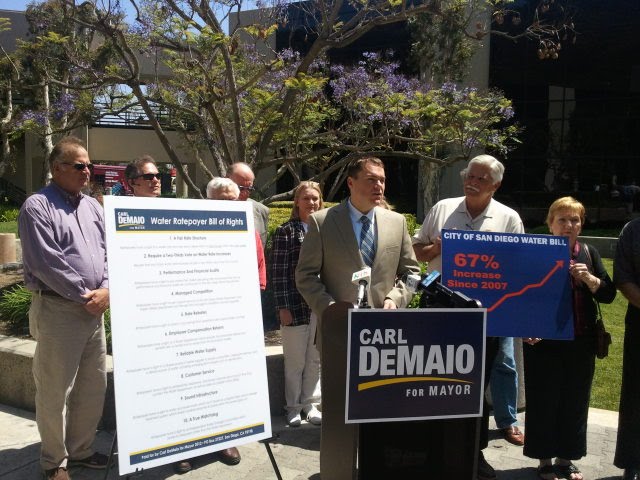
Urges Reform and More Protection For Ratepayers Whose Water Bills Have Increased 67% Since 2007
For the past five years, San Diegans have seen their water rates rise 67%. Mayoral Candidate Carl DeMaio today released his “Water Ratepayer Bill of Rights” to protect San Diego families from outrageous water rate hikes.
“San Diegans have been hosed by higher water rates year-after-year. It’s time we give San Diego working families a break,” said DeMaio.
DeMaio aims to end the abuses by implementing 10 reforms that would protect taxpayers and reward conservation efforts for homeowners by implementing a fair rate structure and require a 2/3 vote on rate increases.
The plan will also implement reforms within the water department like managed competition, employee compensation reform as well as requiring performance and financial audits to target waste.
“One of the most important duties as Mayor is ensuring that our city government is responsible with San Diego tax dollars. It is critical that our Water Department practice fiscal discipline by controlling its spending and reducing the burden on San Diego families,” said DeMaio.
Ratepayers Bill of Rights
1. A Fair Rate Structure
Ratepayers have a right to a water rate structure which allows them to save money when they save water.
2. Require a 2/3 Vote on Water Rate Increases
Require that any future water rate increases require a two-thirds vote of the City Council
3. Performance and Financial Audits
Ratepayers have a right to see where their dollars are going. We must ensure that annual performance and financial audits are conducted on the San Diego Water Department.
4. Managed Competition
Ratepayers have a right to see support services at the San Diego Water Department and Public Utilities Department put through the managed competition process regularly.
5. Rate Rebates
Ratepayers have a right to share in any savings from operations and capital project savings.
6. Employee Compensation Reform
Ratepayers have a right to a Water Department which ensures that employee salaries and benefits are no better and no worse than the local labor market.
7. Reliable Water Supply
Ratepayers have a right to a diverse source of water supplies to ensure competition, adequate reserves, and a steady source of water, including emerging technologies such as desalination.
8. Customer Service
Ratepayers have a right to professional, responsive, and timely customer service each time they contact the Water Department, as well as easily accessible online billing.
9. Sound Infrastructure
Ratepayers have a right to water and sewer mains which don’t break on a regular basis, and a sewage treatment system which doesn’t pollute beaches & creeks when the power goes out.
10. A True Watchdog
Ratepayers have a right to an Independent Rates Oversight Committee which protects ratepayers rather than the Water Department.
Comments 18
Since you became a councilmember in 2008, it seems like you’ve done nothing but campaign for mayor. You don’t participate as a councilmember, you dictate to the council. And for some reason you seem to be aiming to destroy the City’s water/wastewater department (Public Utilities Department).
You’ve voted several times to delay the indirect potable reuse reservoir augmentation demonstration project–which would increase water supply and reliability–without giving reasons. I long ago gave up sending email questions about your take on water issues because they were never answered.
You even voted against the advanced treatment facility for the Water Purification Demonstration Project. Fortunately wiser individuals prevailed. And at NR&C meetings you’ve often been missing during agenda items dealing with water or just goofed off on your computer during water discussions and public comments on same.
Then you insisted you can cut water rates by 15% and freeze that rate for 5 years.
I don’t understand your attitude at all.
Your water proposals are plainly unrealistic and are clearly aimed at uninformed people, and so is this so-called “bill of rights.’
Have you forgotten that the City Council recently passed a new Water Policy sponsored by Sherri Lightner? How thoroughly did you read it and think about it…or did someone just give you an executive summary? By the way, the vote on the nominees for the Water Policy Implementation Task Force is tomorrow (Tuesday May 22)?
Have you seen the list of nominees and understand the breadth of knowledge and experience they represent?
Have you read the latest Urban Water Management Plan or the Recycled Water Master Plan Update or the Recycled Water Study? Those documents together represent about 1% of what you should know before proposing to change things, and distributing politically motivated propaganda like this doesn’t help the city at all.
Nothing seems to matter to you more than becoming mayor and you’ll say anything to get there.
You may know politics, but you don’t seem to know much about responsible water management.
Hi George,
As a reporter who covers water issues, I’d like to see desalination’s costs and benefits directly compared with that of indirect potable reuse. By that I mean a comparison done specifically for San Diego’s circumstances. Do you know if any such comparison exists?
A few years ago, the San Diego Union-Tribune dismissed IPR in a scathing editorial that claimed it would be far more expensive than desalination. Do you remember that editorial, and if so, do you know the source for that contention?
Both desalination and IPR present major infrastructure problems for the city. It’s hard to think of a feasible location off the coast of San Diego for a desal plant. And water produced by IPR presumably would have to be pumped back uphill to customers, which would take a large amount of energy.
A head-to-head comparison of the costs, obstacles and benefits between the two technologies seems to be in order.
Regarding water rates, any meaningful attempt to restrict them on the part of the city seems doomed unless aimed at the price of water at its source. For San Diego County, that means Metropolitan Water District and the Imperial Valley. Both those suppliers, especially Metropolitan, are continually increasing their prices.
It would be possible to bring our cost of water down, if we accepted lower reliability. But higher reliability comes at a premium — It’s an iron law of economics.
Two decades ago, a nearly catastrophic drought caused the area’s leaders to emphasize reliability over cost.
I was there covering the San Diego City Council in 1991 when biotech executives pleaded for guarantees against their water being interrupted. That made a deep impression on the council.
Today’s water rate hikes are the inevitable consequence of that decision. Maybe some of the pain can be eased for low-income customers with tiered rates, but AFAIK the basic plan can’t be easily altered.
Bradley,
I don’t think it is a question of Desal or IPR. We are going to need both and more. The answer to any question about what we should do about water is the same as what we should do about energy: All of the above.
As for the rest of your post, absolutely spot on!
We have a solution to bring water security to San Diego by a full Reclamation of our Public Trust Tidelands, paid for by an 5 percent City-wide only increase in our Transient Occupancy Tax (TOT).
http://www.tinyurl.com/20120201
According to the Mayor’s Economic Competitiveness report, our number one civic issue that requires a solution is the annual $31 million in Fines from the City’s General Funds, increasing to an annual $50 million, for urban Storm Water runoff that empties into San Diego Bay and the Pacific Ocean.
San Diego has nowhere to store any storm water. The structural cistern foundation would provide proof of concept for the full Reclamation of our public tidelands, remove liquefiable soils and toxic sediments and would serve as the stable foundation for a privately financed NFL Stadium/ Convention Center Expansion project based on the AEG’s LA Farmers Field.
1960 – Senator Kennedy promise Desalination as Presidential promise.
1961 – President Kennedy funded 5 Pilot Desalination Project throughout the US.
1962 – The ROGA Plant was built on Point Loma.
1964 – The pilot ROGA Large Scale Desalination Plant move to Guantanamo Bay, Cuba.
Part of our plan for San Diego Water Security includes a new Desalinization Plant on San Diego Bay. Large Scale Reverse Osmosis Desalinization – aka DeSalting was created in San Diego. In 1962 General Atomics in San Diego built the large scale Reverse Osmosis Desalination Plan. ROGA stand for Reverse Osmosis General Atomics The original plant was located on Point Loma by the Wastewater Treatment Plant from 1962 to 1964.
Currently four states including California are trying to invest public funds for a needed fresh water infrastructure project in Mexico near Rosarito Beach. US Federal government has an
EQA/NEPA approved EIR 60 foot Utility corridor Right-of-Way along the US/Mexican border.
Voice of San Diego has published a fascinating article about a new study on the feasibility of turning sewage water back into drinking water. It concludes that the cost is about $900 an acre-foot, roughly the same as importing more water.
If that study holds up — it must be examined carefully to make sure its assumptions are correct — the implications are staggering. Desalinated water at the proposed Poseidon plant in Carlsbad is projected to cost substantially more to produce than imported water, close to $2,000 an acre-foot. (The cost is to be subsidized in the project’s early years).
According to the VOSD story, Mayor Jerry Sanders continues his inspirational leadership on issue:
“So far, it has simply been routed to a City Council subcommittee without any statement from Mayor Jerry Sanders, who until recently has opposed purifying sewage as a drinking water source. His office didn’t respond to an email seeking comment Monday.”
#9 and #5/#7 are incompatible. Plain and simple. Whoever wrote this “bill of rights” knows little to nothing about real water policy.
Bradley,
As a reporter who covers water issues, surely you’re aware that the cost of imported water will continue increasing indefinitely. The speculation is that we’ll face approximately 6% a year increases for imported water for the foreseeable future, subject to our limited ability to negotiate lower rates from MWD.
Then there’s the California Delta…we’ve already been subjected to reduced allocations and increased costs for environmental, regulatory, infrastructure, and drought-related reasons. Further, if the pipeline bypass beneath the Delta plan is approved, that cost will be dramatically high and all southern California water recipients will share in the significant cost of building it…via their water rates.
Indirect Potable Reuse (or purified recycled water or whatever you want to call it) may cost more than imported water today, but it won’t be many years before it will be less and less expensive than imported supplies. In addition IPR will improve the quality of the raw water we now import (especially the Colorado River water which is particularly high in total dissolved solids (TDS) and IPR also represents a relatively drought-proof local supply of water.
The $900 per acre-foot cost of IPR water that you mention is still guesswork …because producing IPR involves an interface with wastewater treatment.
In the City of San Diego, we currently pay 1) a fixed water base fee, 2) a variable water use fee, 3) a fixed sewer base fee, and 4) a variable sewer service charge. How those separate factors get incorporated into calculating the cost of IPR water has yet to be revealed.
I believe the City’s Cost of Service Study update due late this year will shed some light on how that interrelationship will be calculated for IPR.
As for desalination, from the City of San Diego’s point of view, desalination is only indirectly beneficial (because of the reliability factor for San Diego County). The real deal, though, is that the city owns three water treatment plants (Miramar, Alvarado, and Otay), buys only untreated water from the County Water Authority and has no intention of changing that mode.
Since desalinated water is treated water, the city has no plans to buy any desalinated water.
Still, looking at the big picture (being dependent on imported water continuously becoming less reliable and more expensive), locally produced desalinated water (done properly from an environmental perspective) and IPR both should be considered integral to a water portfolio for San Diego County as a whole.
Gentlemen:
This system was indelibly labelled “Toilet to Tap” in the late 1990s and is still a political non-starter.
It’s widely understood within the SD political community that her association with this issue cost Christine Kehoe a close loss to Brian Bilbray for Congress in 1998 (90,516 votes to 86,400 votes). Bilbray’s final TV spot used humor & animation on the issue, and it MOVED the NUMBERS. In baseball terms, Tom Shepard played the Trevor Hoffman role in 1998, and he picked up the Save.
In Business this is called “Consumer resistance”. In Politics we call it “Democracy”. The Public is not Buying this Big Idea.
Mr. Sills:
Don’t be so sure about that. Check this Michael Gardner story (U-T San Diego):
http://www.utsandiego.com/news/2012/may/26/improving-the-flow-to-use-recycled-water/
George,
Thanks for those facts. And yes, I’m very aware that water rates are destined to keep going up, up and up. Everywhere you look on the bucket brigade that gets water here at the end of the pipeline, costs keep rising.
In all fairness, the San Diego County Water Authority has long said reliability of water supply is the top consideration, considering the disastrous consequences of a major shortage. Water is valued as cheap if you have it, priceless if you don’t.
So yes, the ever-ascending staircase of costs makes IPR and desalination look more cost-effective in the long run, along with the bonus of reliability from a local supply.
I agree that the study’s $900 A/F net cost for IPR needs to be confirmed. You can’t just run with that number; it’s got to be critically examined and its assumptions given scrutiny to see if they are realistic.
One of those assumptions is that IPR will save hundreds of millions in avoided costs from upgrading the Point Loma sewage plant. If San Diego were able to get a permanent waiver, those savings would not apply. But such an exemption doesn’t appear likely.
Jim,
I think IPR has been a “non-starter” for grandstanding, egotistical elected leaders who would rather have their name on a downtown Chargers stadium than an IPR sewage recycling plant — even though the latter would be much more useful to San Diego’s economy.
We already drink recycled sewage. Las Vegas discharges its treated sewage into Lake Mead, where it flows down the Colorado River to our taps.
I think the voters in San Diego are ready for a serious discussion of IPR. People are aware that we live in a desert, and a growing population increasingly strains our water supply. Perhaps the next mayor and council will be equal to the task.
Brad:
The same people who pushed for tax-subsidized sports stadiums and generous
pensions for themselves in the 1990s, also advocated the “Toilet to Tap” idea in that manifestely ill-fated era.
The opposition which eventually killed Toilet-to-Tap came from the public and was led by former SD City Councilman Bruce Henderson. Richard Rider correctly calls Mr. Henderson one of the best-ever SD political leaders of the past generation. Henderson demonstrated the idea is Bad Science as well as bad policy.
Jim,
If Bruce Henderson was around back in the day, we probably wouldn’t have Balboa Park. Heck, we might not even have a Federal Highway System. Or, at a minimum these projects would have been delayed and cost significantly more due to frivolous legal challenges.
As for “toilet to tap” being bad science, tell that to the people in Orange County who have been drinking IPR water for years.
Alger,
Marco Gonzalez and Bruce Henderson are useful in advancing perspectives that are otherwise ignored by the political establishment. That doesn’t mean they’re always right, but it’s good to take them seriously. San Diego’s political establishment has often been unwise, misguided and more concerned with their own priorities than the public good.
If Henderson had been listened to, we wouldn’t have had that ticket guarantee boondoggle. But civic boosters, including the U-T’s editorial page, jeered at him.
And Marco helped with the IPR report, which could, if verified, change the thinking about sewage reclamation. Some years ago, a U-T editorial derided IPR as far more expensive than desal. So is the UT editorial factually correct, or have circumstances changed? That’s one of the things I’m interested in finding out.
Bradley,
Directly to your point, I think we will eventually need Desal, IPR, gray water, purple pipe and any other technology we can come up with. And as is the case with most new technologies, the cost of each will come down over time.
I don’t understand why everyone criticizes the so-called establishment for only caring about their own interests, but gives a pass to those that clearly also have their own financial interest in their “causes.”
Alger,
Purple pipe water is an expensive bust. It has to be subsidized. The parallel infrastructure is costly. So why not spend more to treat sewage to a higher standard and put it back into the drinking water supply?
We can certainly use more graywater, but there may also need to be changes in state law.
There is an interesting article in Scientific American about a new desal procedure.
As for the likes of Henderson and Gonzalez, I’m just saying take them seriously, and let’s stop giving near-unquestioning obeisance to the establishment.
The political leadership in this town, going back at least to Mayor Golding, has often placed personal ambition above the city’s interest. Golding wanted to be senator, Mayor 20/20 Vision wanted a sinecure, and Sanders would rather plant a Chargers stadium downtown than take a leadership role on the yucky subject of repurified sewage. Yet such a difficult subject is exactly where political leadership can be beneficial.
Agree or disagree with her, Donna Frye at least was thinking more about what would benefit the city than which bigshots to favor.
We would remind our commenters that this discussion venue is about political differences of opinion, not about personalities, name calling and personal attacks.
A reminder to all, there is nothing more tedious than incessant commenters who can’t keep themselves from needing to have the last word — on EVERYTHING.
Alger, two of your comments above were edited to remove the name calling and an unsubstantiated, inflammatory reference about an individual, which although it may be your opinion, could very well be false.
Yes, we will edit and/or remove comments as we see fit, if we deem them to violate our oft-stated rules.
If it’s good enough for Disneyland, it’s good enough for San Diego: http://youtu.be/ZKZR5Lbyeds.
Alger, these matters that Henderson was involved in were hardly frivolous. The “Charger ticket guarantee” stadium renovation deal went to the CA Supreme Court. Frivolous cases don’t go there.
Indeed, I wouldn’t characterize even your unions’ drumbeat of project-blocking lawsuits for “environmental” purposes as “frivolous.” Instead, such lawsuits are outright malevolent extortion — and everyone fully understands that. Including you, my anonymous friend.
BTW, Henderson won on the his water tertiary treatment plant lawsuit, saving San Diegans between two and four BILLION dollars (given the govt’s record on such construction, I’ll go with the $4+ billion figure). Hardly chump change.
And remember, that lawsuit was for water that would still be dumped into the Pacific — no recycle benefit whatsoever to San Diegans. And, BTW, the Scripps Institute of Oceanography and the Sierra Club agreed with Henderson.
Also, note that Henderson chose not to seek lawyer fees, which would have been substantial. The Sierra Club piled into the case at the last minute, gaining hundreds of thousands of lawyer fees, as is their nature.
Contrast that with Lorena’s bro, who now shows up as regularly as June Gloom to file “environmental” fireworks lawsuits before the 4th of July. I think he seeks major legal fees for his selfless efforts — correct me if I’m wrong.