





Added Preface 5/19/26…
As a result of the below column, posted yesterday, I received a few “hate missives,” which I anticipated. That’s fine.
What I didn’t expect was several credible readers complaining that I buried the lead at the end. Frankly, the ending paragraph was nearly a throw away, included at the last minute only to wrap up the piece with some semblance of hope for those not liking my overall message.
But maybe that’s what readers want. So, I guess I’d encourage reading the end, even if you don’t read the whole thing.
I’ll sum it up here a different way. Whether I’m right or wrong about a Republican having no chance to be Governor come November, that last paragraph still holds. You don’t win elections by having folks sit behind screens advocating or arguing with those already on their side.
Real campaigning, not social media/meme/PowerPoint politics. Clicking the ‘like’ button is not campaigning, nor is it moving the needle for your candidate or cause.
Original Column 5/18/26…
In no prior California election do I recall so many wasted words being used to debate the difference between two Republicans with so little chance of becoming Governor.
Ok, that’s being too nice. It should be zero chance of becoming Governor.
Chad Bianco. Steve Hilton. Two qualified guys, don’t get me wrong.
Yet, their qualifications don’t matter. The ability to win in a California general election is the only thing that does.
Neither has the ability to win. Why not? Well, that’s the reality of California politics.
The Reality
Two Republicans are never — and were never — going to finish as the top two in the primary election. Never. Too many people discussing and debating a pipe dream, for months, completely wasting time doing so.
If one Republican makes it through the primary, which increasingly seems likely, that candidate will be annihilated in November. Voter registration alone dictates the outcome. Every reasonable voter turnout scenario shows it to be the case, even with a low water mark for Democrats combined with record high turnout for Republicans.
Let’s start by looking at changes to California voter registration by party over the last 26 years. This data shows the pre-November election numbers in each year, with 2026 being fairly current:
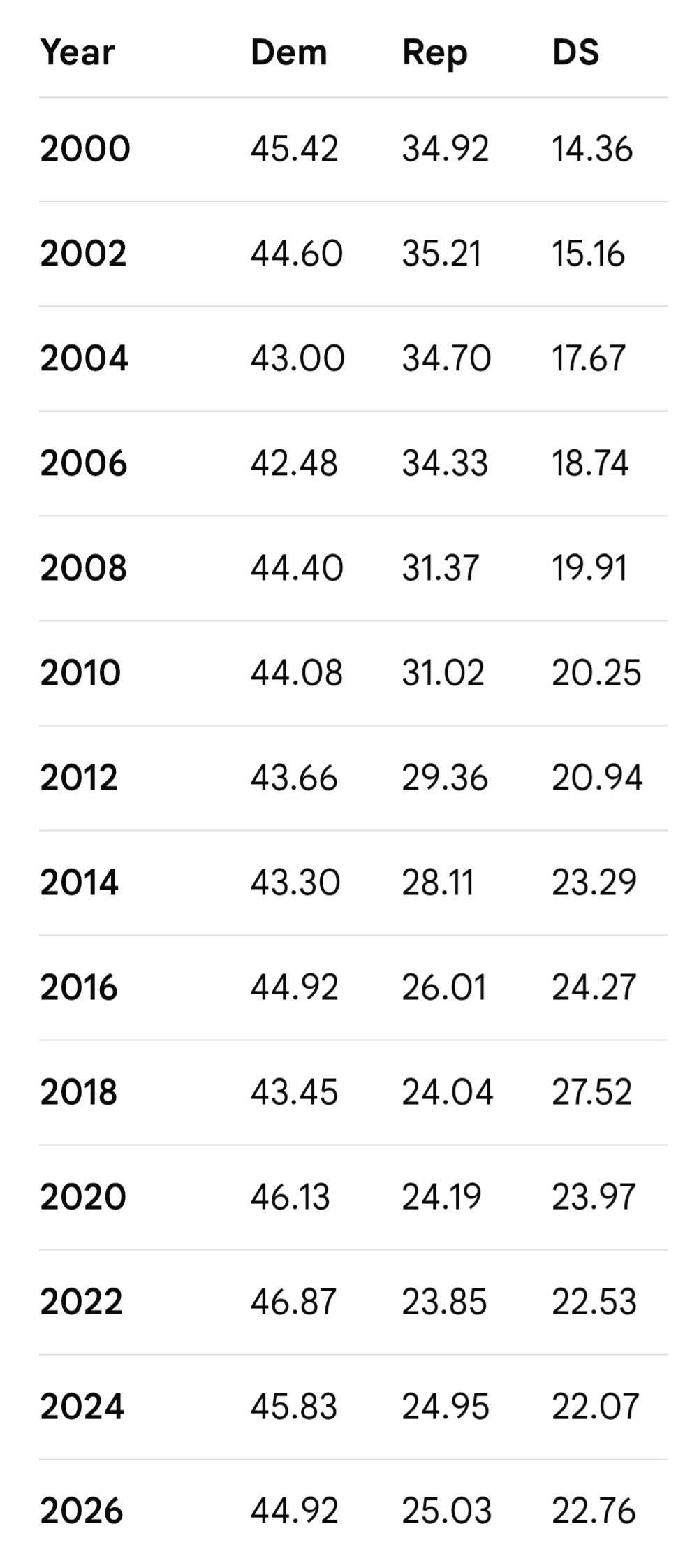
In a nutshell, over a 26-year-period Democratic registration has barely changed, while Republican registration has dropped by about 10 points. In the same period, decline-to-state (DS) voter registration has increased by a high-water mark of 13 points, then leveled off, now over eight points higher than it was in 2000.
Back then the margin between Dems and Reps was about 10.5 percentage points. Now, Dems have a nearly 20 point registration advantage.
Sidebar: By the way, if you believe these numbers are fake; if you think there’s no way Republican registration is that much smaller; if you claim this is all part of a rigged, fabricated election system, I simply suggest you stop reading now. Go to your fake moon landing website or something. I’m done trying to explain to cultists why they’re part of a cult.
Back to Reality
There are good reasons why decline-to-state voters continue to increase in numbers, most notably younger voters showing disdain for party labels and viewing themselves as fiercely independent.
That trend, however, has not impacted Dem registration; it’s only been to the detriment of GOP registration.
Let’s be clear. Voters are not failing to register with the GOP so they can then go out and overwhelmingly support Republicans.
Next, let’s look at how Republican gubernatorial candidates fared in general elections during roughly the same period of GOP registration decline:
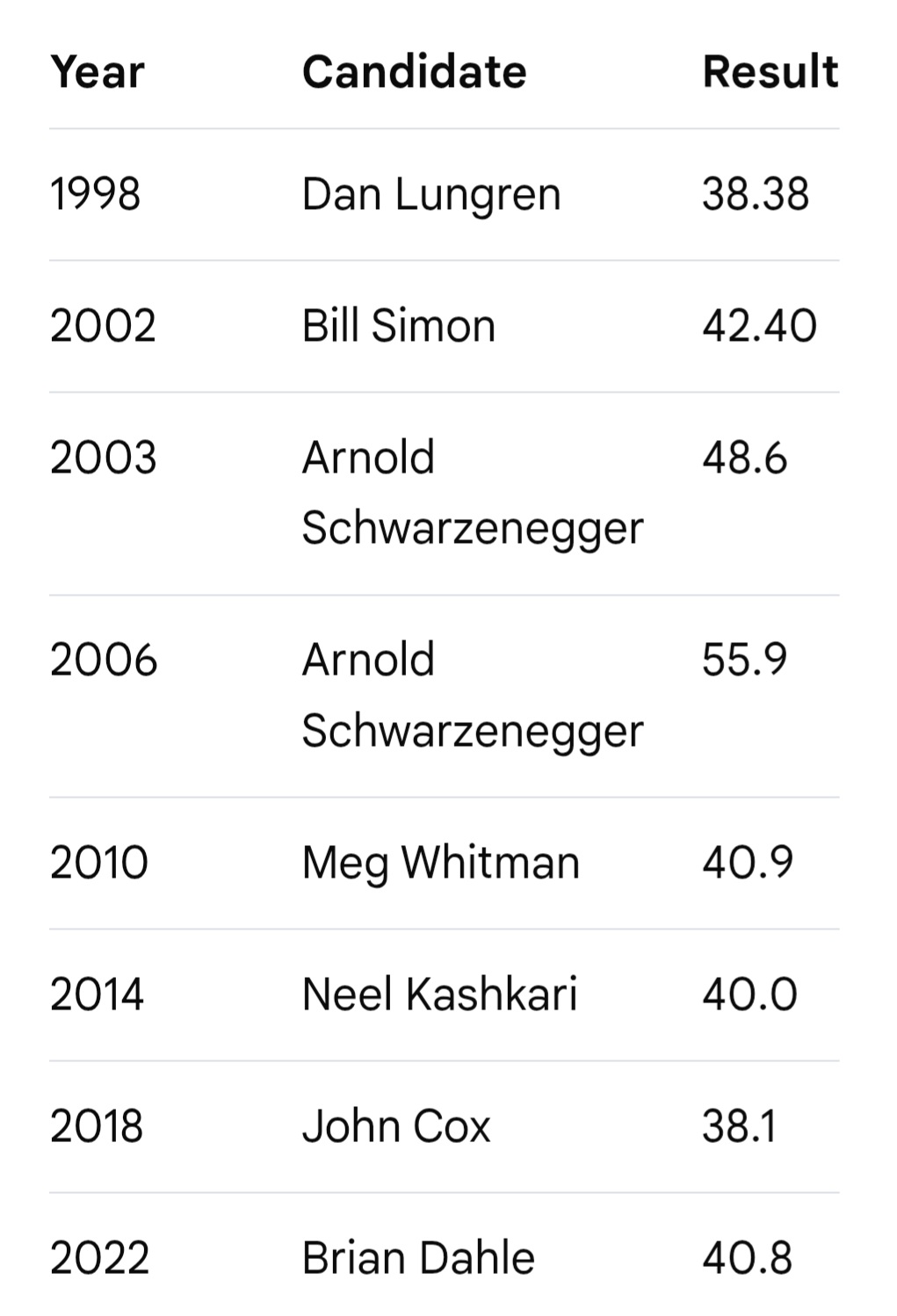
First, the Schwarzenegger results in 2003 and 2006, when he won both elections, are anomalies. The 2003 affair was a recall election won by a plurality (not a majority), with other Republicans also on the ballot. In 2006, Schwarzenegger was then running for re-election. In both those years, voters largely weren’t voting for a Republican, they were opting for an international superstar.
Additionally, Republican registration in the “Arnold” timeframe was still over 34 percent, not the 25 percent it is today.
The real comparison by today’s standards is the results over the last four governor elections, a period in which GOP registration slid from 31 to 25 percent. In no case did the Republican candidate exceed 41 percent of the vote.
That’s roughly where I’ll predict a Republican candidate for Governor will end up in November.
I know many will argue all this “registration numbers talk” is irrelevant, that other factors will drive a significant shift this year in favor of a Republican.
The factors:
Economy/Gas Prices — The claim is that negative economic factors will drive masses of usually partisan voters to reject current Dem leadership. However, politics doesn’t work that way. Partisan voters — those who always end up voting for their party’s candidate, regardless of often loving to say they “vote for the person, not the party” — will still do so, as they always do.
Most voters simply do not translate any negative perceptions of their well-being into being the fault of their own party.
Voter Cross-Over — See directly above. The argument is that many Democrats are so upset with the general state of things that they will vote Republican, joining hordes of independent, decline-to-state voters, thus making up for the Republican registration disadvantage.
That’s simply not reality. There’s always a certain amount of cross-over voting, sure. Independent voters end up leaning one way or the other, absolutely. Those nuances and variations mean something in close, competitive races, not in elections that start as a blowout before the votes are even cast.
Voter Turn-Out — In this scenario, the hope is Republicans will turn out to vote in significant numbers while Democrats “stay home,” thus covering the GOP disadvantage. Again, in no statewide elections does this ever take place. Even a few percentage point difference in turnout between Reps and Dems doesn’t make up for the significant registration gap. In a close local election, yes, not with a 20 point difference.
The Trump Endorsement — The thinking here — and ‘thinking’ is a stretch — is that Donald Trump’s support of Steve Hilton will drive the former Fox News host to victory. Yeah… no. In the primary, it means something. Not in a general election. The Trump support motivates his base at least as much as it motivates those who detest him.
Trump himself has not fared well in California and the “Trump era” Republican candidates for Governor, John Cox and Brian Dahle — as the chart shows above — have done no better than their predecessors.
All of the Above — Here’s the thought that all those things working together will make things different. Sorry, the math simply doesn’t get you there. Again, it’s a nearly 20 percentage point gap.
I shouldn’t leave out the reason many will say I’m absolutely correct, but for the wrong reason…
Voter Fraud — Yep, the increasingly common “go to” when you can’t win is to blame a fraudulent, rigged system. But, voter fraud, where and when it exists, impacts close elections, not blowouts. The simplest reality is that there is no reason for anyone to implement a widespread vote fraud conspiracy in a state where there’s absolutely no need for one.
I know, some of you will say I’m sadly blind to the conspiracy, I have the wool pulled over my eyes and my head in the sand; that I’m a sheeple. Frankly, I’m surprised you read this far. There’s still that fake moon landing site.
All in all, Trump doesn’t change the reality of California. Neither do high gas prices or a suspect economy. Not enough voters translate any of those matters into doing anything other than they normally do at election time. That reality doesn’t change drastically from one election to the next; trends take several years. As noted previously, the Republican registration decline didn’t happen overnight, it’s been a long downward trend.
The reason for having a Republican candidate at the top of the ballot is still pretty simple from a political perspective. It’s to help motivate Republican turnout enough that it impacts close, competitive down-ballot, local elections, where the previously mentioned nuances do mean something to outcomes.
Voting does matter, significantly, whether or not the top spot is out of reach.
Republicans will hate this message, I know. (The upside is maybe they’ll stop asking me for money!)
As well, those in the consultant class don’t like this kind of talk, as they often make dollars by convincing candidates with no chance to raise and spend money anyway.
That’s simply part of the reality.
If you don’t like this reality, the long upward trend of change has to start somewhere. It starts with getting off social media, where activists are wasting their time arguing with others in their own party about Hilton vs. Bianco, and instead getting out and doing something that actually has an impact on winning elections.