


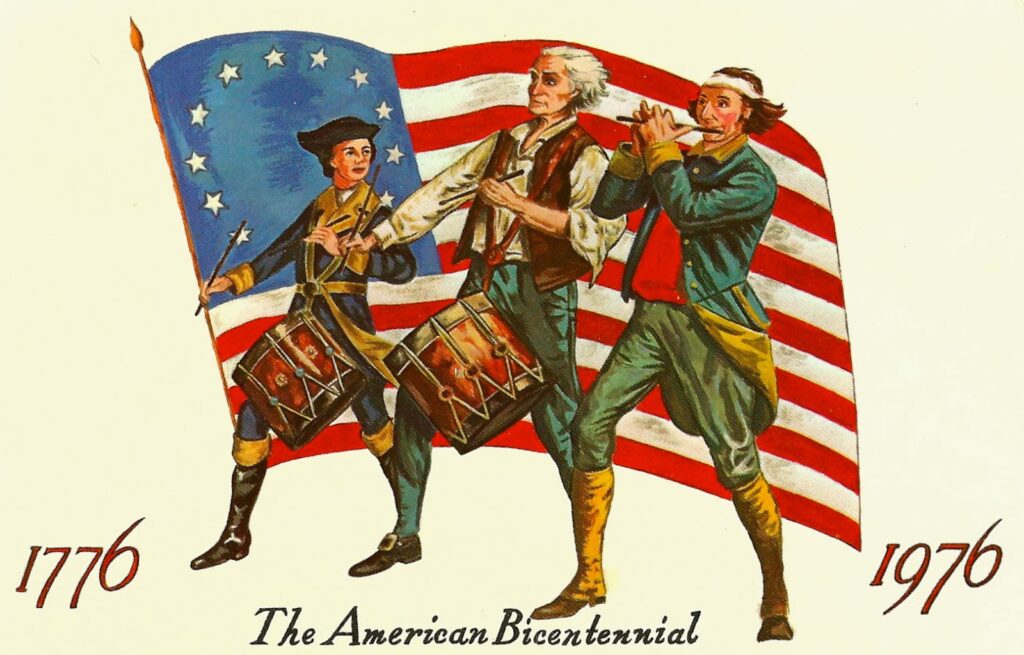


Author’s Note: Below is an essay I wrote several years ago as part of a book of essays on Substack. I post it here the spirit of the 250th anniversary of America’s founding.
Joe Sheffo is a resident of Encinitas and a former editor at the North County Times. More recently, he has worked as an auditor for the State of California, including nine years at the State Auditor’s office.
I have always considered myself to be an orthodox Catholic and an economic libertarian, which means in, practical terms, I am firmly in the free-market, socially conservative wing of the Republican party. But I’ve recently come to the conclusion that these tenets may not be solid enough ground on which to stand against the threats to our freedoms. So I have begun to take the first tentative steps towards becoming an anarchist.
Anarchism is a scary word. It immediately suggests lawlessness and disorder and violence. That is not how I mean it. That is anarchy, to which I, and any other reasonable person, am opposed.
I am instead considering anarchism as a political philosophy, not a state or condition, which has many variations along the spectrum.
As stated above, I am an orthodox Catholic; not a modernist reformer or ultramontane (at least for now). I accept the Catechism of the Church as it has been taught and practiced for 2,000 years. And I am not a libertarian who embraces all forms of human behavior as long as that behavior is freely chosen, although I am sympathetic to that idea in theory. (Unfortunately, when it comes to humans there is no “theory” only hard reality.) Certainly, there are all kinds of anarchism: left and right, violent and nonviolent, religious and firmly secular. In this, it is like any other political philosophy or attitude. It is surely possible to find a suitable place on the anarchist spectrum, and that is my intended goal.
To begin with, let’s to do away with the most the most common objections to anarchism. I am opposed to any form of anarchism advocating the violent overthrow of society. This is not because I am opposed to violence but because it cannot be done. The anarchist non-society will, in short order, simply become an anarchist society with all of the same defects and flaws as the (supposedly) corrupt society it replaced.
That said, a certain type of righteous violence is the foundation of all human freedom. From the Maccabees resisting the Seleucids to the American colonists rising up against the British to more contemporary examples of people standing up to oppression (such as Ukrainians at this very hour), violence directed toward principled, justifiable, moral goals will always—must always—be a last resort.
And I am not opposed to a certain militancy. In fact, it is my recent revelation that such a militancy will be necessary to preserve our freedom as Americans that has led me toward anarchism. This militancy would be similar to the nonviolent resistance practiced by the American civil rights movement in the 1960s. Except, in our own times, it would involve not a repressed minority but a vast middle of a country that still holds to the traditional ideas of what it means to be an American. I think this is what many in the Tea Party and Stop the Steal movements have had in mind, to little avail. What will be required is genuine sacrifice and witness bearing of the type seen in all successful social movements. And it must be backed by the threat of violence.
Next, there is the charge of lawlessness. This accusation is partly accurate. For law is an extension of government, and the elimination of government is the goal of anarchism. But it does not mean disorder. In fact, order without an explicit legal basis exists in even mature societies. It might even be called the basis of all society. It may be the best kind of order because it is largely voluntarily and self-enforcing (although usually backed by powerful social forces). This is the order built on the foundations of a preexisting, informal institutions, customs, manners, and traditions. If one doubts this, consider that an overly litigious, legalistic, and regulated society (say America circa 2020) is a social order in collapse, the need for more formal rules being a desperate attempt to replace the previous informal ones. Anarchism need not mean chaos. But it does mean reducing power to its most organic and circumscribed form.
So then what is this anarchism that I am describing? In my mind, at least, anarchism means the simple acknowledgement that government—all government—is evil. To a society that has become addicted to government, this may seem like a radical idea, and it is. But it is not foreign one, especially to Americans. Our Revolution was an extension of the Whig revolution in England that was defined by its suspicion, distrust, and outright vilification of the various schemes of government and government officials.
“So, what’s so evil about government?” you may ask. “Don’t we need roads, schools, fire, police?” Ok. And if coerced social action for a few public services was the extent of government you’d have no argument from people like me. But that’s not what government is. Government is a blank check to any person or group of people who can seize control to impose their vision on a society and then use the coercive power of the state to punish those who object.
Even worse is the government that seeks to do good. Every government program promises to solve some social ill and inevitably fails, sometimes at the cost of billions of dollars and untold human lives. (Or succeeds in achieving some limited goal and is then expanded to achieve some impossible one. In such a way have the public schools been asked to solve every social ill when they had previously been asked to solve only illiteracy.) Every war is fought for some worthy reason and falls short, leaving death and destruction in its wake. More recently we have seen in this country and throughout the West the ascension of a left-wing elite who seek mainly to ensure their own continued economic and social success (in the name of “progress,” of course) while punishing those they deem backward. In the process, they’ve created a form of colonialism within their own countries that, at this point, is almost insurmountable.
The genius of America is that it was the first country to establish the idea that there were certain areas of human endeavor—speech, religion—off limits to government (“shall make no law”). And one can go down the Bill of Rights: “shall not be infringed,” “shall not be violated,” “nor shall be compelled.” This is not equivocating, compromising language. It is absolute, anarchist language. Certain natural rights, such as property, were so sacrosanct that they were not even mentioned in the Constitution (beyond the prohibition against takings in the 5th Amendment) because no one at the time contemplated that they needed protection. What free people would be so foolish as to give up their rights voluntarily? Our Founders pursued a form of anarchism and America was, until the Civil War, more or less a functioning anarchy.
But the idea that some rights are so self-evident they don’t need formal protection is long dead, and the formal rights are just hanging on. Government begets more government. Power expands. The idea of a limited, federal government is dead.
So why not just become a libertarian, then? Because aside from a few exceptions (Ayn Rand is perhaps the best example) libertarianism is just a default position for people who do not want to be judgmental. It is to political discourse what Unitarianism is to Christianity. Don’t get me wrong: a muscular economic libertarianism that believes that market decisions are sacrosanct (the kind I embrace) goes quite a bit along the road of the type of anarchism I am proposing. Markets are a form of controlled chaos based on private agreements and free exchange. And although mature markets usually develop formal laws and regulations to standardize commerce, such a formalization is not necessary for markets to function. In fact, such standardization—or nationalization if you will—is exactly how government seeks to expand its power. Which is why a libertarianism based on economics is not sufficient. There must be a moral and ideological counterweight.
The libertarian credo, if reduced to one idea, is this: human behavior, ultimately, cannot be controlled, so don’t even bother. An addendum: any attempt to curb individual choice is, ipso facto, tyranny. This gives way to a hyper-individualism that treats all beliefs and behaviors as being equally legitimate. Thus, any lifestyle choice—from drug use to sex to reproduction to family structure to identity—becomes sacrosanct in the way that market forces are under the pure economic libertarianism mentioned above. It is, at base, another form of faith in human progress (a faith which I reject). Combined with the libertarian penchant for open borders and technology as a saving grace, and you get the kind of real chaos that has infiltrated almost every aspect of contemporary American life.
But certain ideas are so fundamental they cannot be left to chance, and that requires a deliberative effort. As G.K. Chesterton argued in another context, to let nature take its course, to be “libertarian,” is to sacrifice the very thing one cherishes. To quote at length:
If you leave a thing alone you leave it to a torrent of change. If you leave a white post alone it will soon be a black post. If you particularly want it to be white you must be always painting it again; that is, you must always be having a revolution. Briefly, if you want the old white post you must have a new white post.[1]
The “white post” of course is anything worth defending. While that could include any number of aims, the “thing” that needs defending is Truth. The fate of humanity cannot be left to chance. Individuals, societies must exercise judgement to determine when intervention (the painting of the post) is necessary. This is why I am not a libertarian.
Speaking of truth, my interest in exploring anarchism as a legitimate alternative to more conventional is in large part based on my faith. As Jacques Ellul has noted in his book “Christianity and Anarchy,” the main thrust of the Bible, particularly the New Testament, is a rejection of worldly power. Instead, we are told repeatedly to have trust in God. This is most obvious in the figure of Christ, who was repeatedly tempted by the devil with the promise of temporal power:
Then the devil took him up to a very high mountain and showed him all the kingdoms of the world in their magnificence, and he said to him, “All these I shall give to you, if you will prostrate yourself and worship me.” At this, Jesus said to him, “Get away, Satan!” (Matthew 4: 8-10).[2]
And when Peter tried to convince Jesus to turn back from his fate of crucifixion, in other words to preserve his life in order to achieve certain worldly goals:
He turned and said to Peter, “Get behind me, Satan! You are an obstacle to me. You are thinking not as God does, but as human beings do.” (Matthew 16: 23)
What I find more compelling, are the examples in the Old Testament which point to the specific evils of government. For instance, in Second Samuel when Joab challenges David’s demand for a census, which David later regretted (“I have sinned grievously in what I have done. But now Lord, forgive the guilt of your servant, for I have been very foolish.” 24:10). For the power to count people is the power to control people. Only the Lord should know the exact number.
But it is the first book of Samuel which has the most explicit and stern example of misplaced faith in government. Samuel, the last of the judges and the first of the prophets, was asked by the Israelites to appoint a king over Israel. His warning:
The rights of the king who will rule you will be as follows: He will take your sons and assign them to his chariots and horses, and they will run before his chariot. He will also appoint from among them his commanders of groups of a thousand and of a hundred soldiers. He will set them do his plowing and harvesting and to make his implements of war and the equipment of his chariots. He will use your daughters as ointment makers, as cooks, and as bakers. He will take the best of your fields, vineyards, and olive groves, and give them to his officials. He will tithe your crops and your vineyards and give the revenue to his eunuchs and his slaves. He will take your male and female slaves, as well as your best oxen and your asses, and use them to do his work. He will also tithe your flocks and you yourselves will become his slaves. (First Samuel 8: 11-17)
Kingship—even (especially?) if based on popular acclaim—proceeds in only one direction: tyranny. More than two thousand years later, Thomas Jefferson, a true anarchist if there ever was one, would express the same idea when he said that “a wise & frugal government…shall not take from the mouth of labor the bread it has earned.” (First Inaugural address)
Faith. That is the true difference between the statist and the anarchist. Faith that men working together can devise ways of social action independent of government. Faith that prosperity and stability are the fruits of such social action. Faith that God alone will provide. Despite popular misinterpretation (mostly by socialists calling themselves Christians), Mammon should not be understood as wealth, but anything man puts faith in other then God.[3] This would include government, and politicians, and political parties, and technology, all of which have in our world become combined to form another menacing biblical metaphor—The Leviathan.
“So what is the way forward, then?” I hear you say. “What is the course of action—the plan—to fix the state of affairs you describe?” The course of action is no action at all. The plan is to destroy all the plans, for it is the plans that have gotten the world into the mess it’s in. Or rather, the plan is to acknowledge the world as it is: that human nature is fallen, that the human condition is tragic, and that attempts to fix it only result in further distortions.
For example, the plan to fix poverty in America was a number of social programs, which would address the supposed causes of poverty: ignorance (Headstart), malnutrition (food stamps, school lunches), neglect (child protective services and foster homes), ill health (workers’ compensation, Medicaid, disability insurance), and bad luck (unemployment insurance). Nearly a century on (Aid to Families with Dependent Children was created in 1935), the result is a society in which a sizable portion of the populace is no longer able to take care of itself.
Take, for instance, a state like California, which has some of the most generous social welfare programs in the country, up to and including subsidized university education, and also the biggest homeless population in the country. As Michael Shellenberger argues in his book “San Fransicko,” the homelessness crisis is caused less by the lack of affordable issue in the state (a significant issue) than from the inability of people to take care of themselves due to broken families, drug use, and mental illness (which causes which hardly matters). If the plans worked, poverty in the state should be on the decline. Instead, they have simply bred a new form of dysfunction (mass homelessness) that now requires an entirely new set of social programs that are doomed to fail.
The modern world has become unreformable. There is no hope of effecting the kind of change needed through existing channels, even democratic ones. Sadly, this applies to America as much as it does communist China or Putin’s Russia. If anything, the combination of an omnipotent government with all pervasive technology companies and an Orwellian media system have made the likelihood of real reform even more remote. Something more than a laissez-faire optimism that things will work out or party platform with a ten-point plan are needed to save America from a very dark future.
[1] Orthodoxy. Ignatius Press, 1995. P 122.
[2] All biblical quotes are from Catholic Study Bible. New American Bible. Oxford University Press. New York, NY. 1990.
[3] Mammon is the Greek transliteration of a Hebrew or Aramaic word understood to mean “that in which one trusts.” The Catholic Study Bible, 1990.