



(UPDATE: With new graphic illustrating press release journalism.)
In honor of Al Gore’s global warming scareathon beginning Thursday Wednesday, here’s a phony climate scare story, carelessly reported by City News Service and carried uncritically by our local public media outlet KBPS radio, and independently by the San Diego Union-Tribune.
First, please examine this chart. I’ll explain why it’s important later in this post.

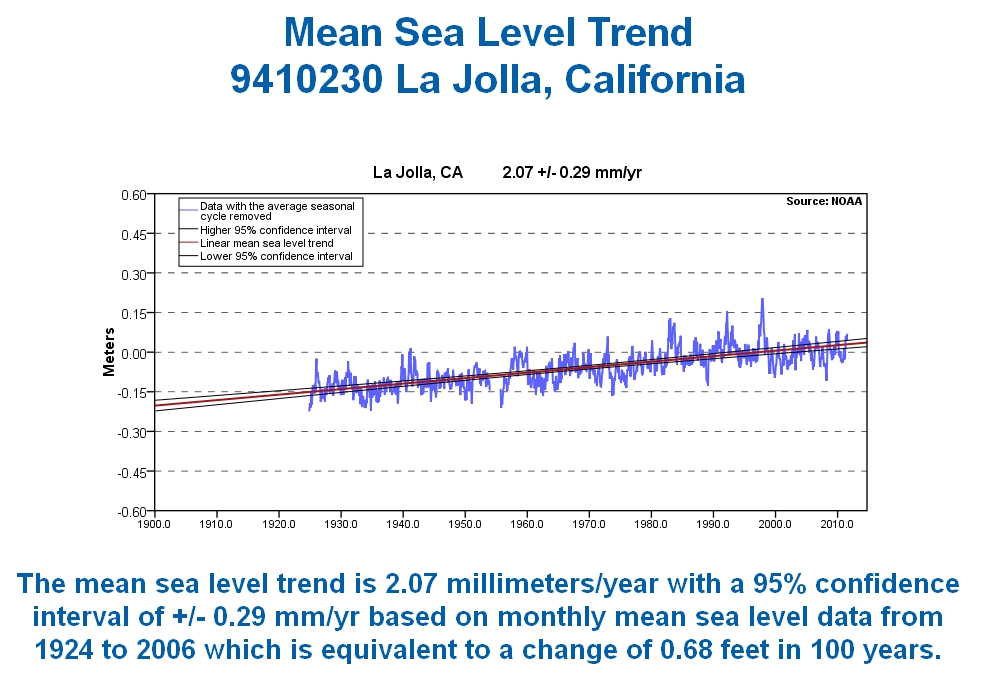
La Jolla sea level rise, from NOAA - 2.07 millimeters per year
The story lead (my emphasis) says:
“Torrey Pines state and city beaches, and other coastal areas in the state, could be submerged by the year 2100 if ocean levels continue rising at current rates, according to a state-commissioned study released today by San Francisco State University.
“Torrey Pines would be completely swamped if coastal-water levels rise by 4.6 feet by the end of the century — a projection specific to the California coast based on recent studies, according to the report, which pegged the economic loss due to a reduced tourism at $99 million between now and 2100.”
Copied from a press release
The story on KPBS’ Web site doesn’t give any links to the actual study, or even the press release for it. The City News Service article includes verbatim quotes from the press release, a fact it fails to mention.

Now there’s nothing wrong per se with quoting from press releases. I do it frequently in my own science reporting when I can’t contact an author in time. However, I disclose that I’m using a press release, so as not to mislead the reader. Whenever possible, I also include a link to the actual peer-reviewed study — and I do read the study.
The press release is supposed to accurately reflect the study, but to be sure, you need to see the actual statements in the study. A statement that isn’t in the study doesn’t have the same authority as a statement that reflects what’s in the study. The only way to know for sure is to read the study.
Now please look up to the chart I embedded at the beginning of this post, from the National Oceanic and Atmospheric Administration. It states that the annual rise in sea level in La Jolla averages 2.07 millimeters per year, or 0.68 feet in 100 years. In other words, the projected rate of increase in the study is nearly 7 times greater than the measured increase. The story fails to explain this wide gap between prediction and measurement, or even to mention it.
Special bonus note: The press release claims the study was “peer-reviewed,” which supposedly means it was examined by independent scientists. In fact, the study was funded by one state agency, the California Department of Boating and Waterways, and “peer reviewed” by another agency chosen by the state, the nonprofit California Ocean Science Trust, given mandatory oversight power by state law.
Far from providing independent review, the study looks like it was funded by one state agency and in effect reviewed by another state agency. And peculiarly, the press release doesn’t include a link to the study, titled, “The Economic Costs of Sea-Level Rise to California Beach Communities,” and I can’t find it on the Web. You apparently have to email the researchers to get it.
Digression: KPBS has a science reporting problem
KPBS styles itself as providing quality reporting for an educated public. Can’t it do better on such an important scientific topic than to run a third-rate story, from another outlet, that’s just a rewrite of a press release?
I’ve recently criticized KPBS for another recently botched science story, this one about the opening of a center for studying RNA interference. Amazingly, the error-filled story was done by a KPBS staffer hired to specialize in science.
Worse, KPBS hasn’t corrected the errors in the story, such as calling RNA interference “RNA interface”.
Financial contributors to KPBS should mention these examples when they’re asked to pony up. It might light a fire under KPBS to improve its science reporting. If you care about science, don’t be satisfied with poorly rewritten press releases.
The U-T, by the way, deserves praise for its very well-reported story on the RNA interference center. We need more stories like this, that put the science in context and explain its significance in terms the average educated person can understand. My own blog post was workmanlike, but nothing special.
U-T fails to mention pertinent facts
Getting back to the ocean/climate story, The Union-Tribune similarly published another inadequate version. The U-T story also failed to mention the widespread gap between observed and predicted sea level rise. The U-T reporter also copied from the press release without telling his readers. (Here’s a good way of checking if a story was taken from a press release: Google some quotes, and see if you come up with a press release or lots of identical quotes. Click here to find some copycat quoting.)
One of the few bright spots in the misleading U-T story is that the reporter mentioned from the start that the feared sea level rise is a projection, not the current rate of increase. The comments show that some of the readers are raising uncomfortable points. Here’s one:
This article failed to report that the sea level at Scripps Pier in La Jolla has, on average, actually declined over the first decade of the 21st Century, compared to the last decade of the 20th Century. This is an observable decline, not a fuzzy forecast from a computer model 90 years in the future. There is no sign in the tide station data at Scripps that this decline is going away soon. Funny how the researchers mentioned in this article didn’t discover this basic fact, or address it.
It isn’t clear why, in these tough financial times, public moneys should be spent worrying about a problem that hasn’t manifested itself for over ten years, and which may not appear during the next ten years. Perhaps we should fund programs to deal with the possible landing of flying saucers from Mars, as some predict that they will arrive by the year 2100.
And here’s another comment on the U-T story raising other important points not addressed in the article:
This is either very lazy reporting or very intentionally deceptive reporting. The article talks about the effects “if the sea level rises 4.6 feet.” Why not “if the sea level rises 46 feet”? Even the IPCC 2007 report estimates sea level rising only 7 to 23 inches. Don’t you do any fact checking on what you are reporting? Centuries ago, the Dutch figured out how to live in a country that had a large portion under sea level. As technology improves, methods will be found to deal with this. However, how critical is it to even deal with a sea level rise of 7 inches – The difference between hgh tide and low tide today was 49 inches.
The sea level has risen 8 inches in the last century. Yet, it is somehow plausible to you that the sea level will rise 55 inches in the next 89 years?
And yes, I’ve been the recipient of such criticism myself. I strive to improve my reporting in response.
I hope the Union-Tribune’s editors and ownership are paying attention to these comments and not ignoring them, as newspapers too often do. And when their reporters quote from press releases, make them say so in the story.
Breakdown of journalism on climate issues
But outside of San Diego County, the journalism gets even worse. Another story about the alleged threat from sea level rise, this one for the Central Coast on the Web site for KCOY, hilariously claimed to give the full study, when all it did was append the press release.
This is what passes for serious climate journalism in our mainstream media. Press releases leap from the publicists’ email to by retyped by reporters’ fingers, untouched by human thought. The problem isn’t likely to cross the minds of a fuzz-brained reporter who doesn’t even know the difference between a study and a press release.
It’s easy to grab headlines by making sensational predictions. Journalists are supposed to be aware of this and exercise skepticism about extreme claims not supported by real-world observation. But skepticism has become a dirty word in climate science, and critical coverage of climate science has become an endangered species.
At some point, journalists are going to have to talk about the growing gap between the fearsome predictions of sea level rise and the much smaller rise in the observed data.
I’d say the time is now. Even at risk of being ostracized as a “denier”, it’s time for journalists to ask climate scientists some tough questions about the gap between the observed data and projections, and how many years it will take before their ideas are confirmed or falsified.
——————————————————
(DISCLAIMER: This is my opinion, not necessarily that of my employer, the North County Times.)