



What about taking on rapidly increasing water rates?
Guest Commentary
by Mark Robak, Board Member, Otay Water District
What five members of the San Diego Local Agency Formation Commission (LAFCO) Board did Monday was incomprehensible, in blocking the proposed merger of the Fallbrook Public Utility District and the Rainbow Municipal Water District in North County. Worse yet, all five are Republicans; ones you think would want more efficient government.
LAFCO staff had recommended the merger go through, estimating it would save more than $2 million a year in reduced administrative and other costs.

Carlsbad City Councilmember Lorraine Wood, San Diego City Councilmember Lorie Zapf and Vista Irrigation District Jo MacKenzie joined San Diego County Supervisors Bill Horn and Dianne Jacob in rebuffing the recommendation.
So, what did these five officials hear that swayed them from saving money? Rainbow Water argued against the merger, saying they wanted “to retain local control,” which is generally the reason offered up by opponents fighting such consolidations.
Local control. That sounds good on the surface, but it’s not like a nameless faceless person from some other state would be taking over. It would have meant many of Rainbow’s existing board members as well as Fallbrook board members and others elected by the community. All local elected officials.
Why then was the consolidation considered by LAFCO in the first place? All consolidations, either voluntary or involuntary, go thru the agency, as the mission of each LAFCO (58 of them in California, one per county) is to provide assistance to local agencies in overseeing jurisdictional boundary changes.
In this case, a voluntary consolidation was initially jointly sought by Fallbrook and Rainbow. But after the voluntary effort between the two agencies fell apart, Fallbrook pursued forcing the consolidation.
Why did the voluntary consolidation efforts break down? Good question. For close to a year, Fallbrook and Rainbow did a functional consolidation of both agencies, including eliminating duplicate positions and sharing resources. The two agreed the savings were substantial, ranging from about $600,000 to close to $1 million annually.
Unfortunately, Rainbow backed out of the merger, even though it saved money, because its board members couldn’t agree on how they would get elected, either geographically or at large.
In other words, the Rainbow board members were afraid they might lose their elected seats.
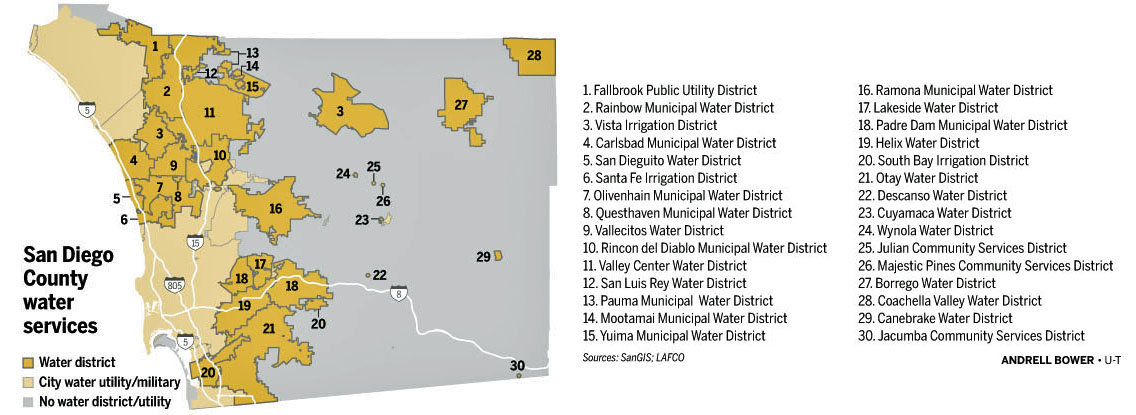
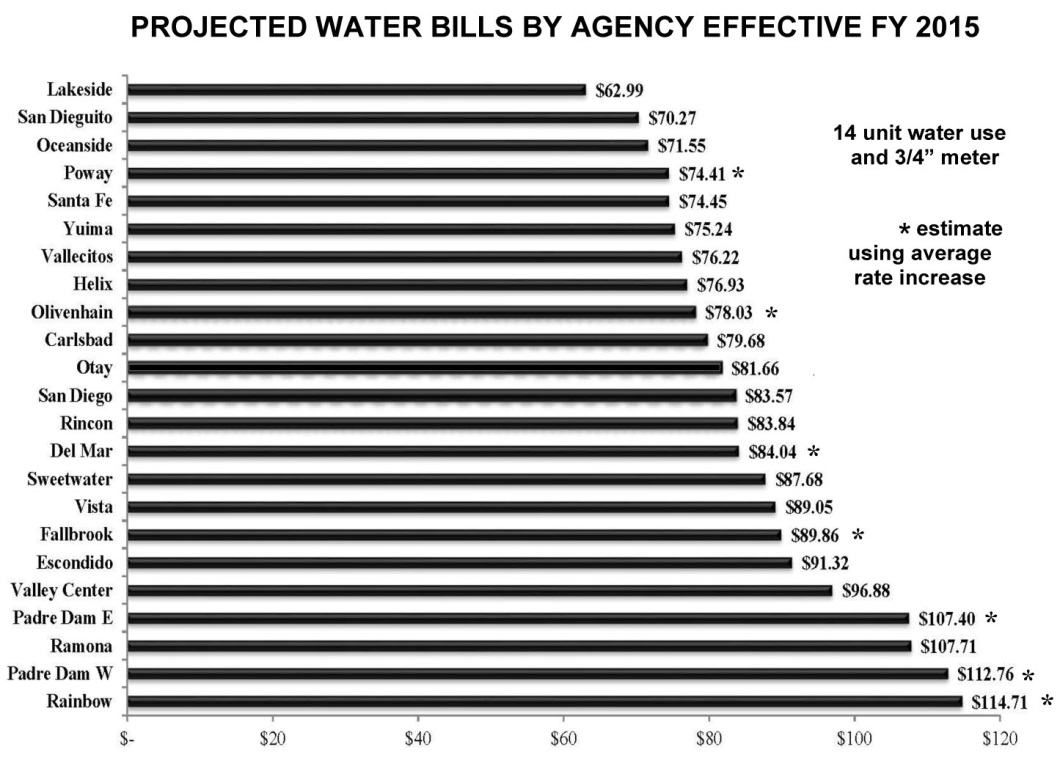
Looking at the bigger picture, there are 24 water agencies in San Diego County. Being that we essentially have one electrical utility, I think we can agree that 24 districts is far too many. If we can consolidate some of those agencies, there will be real savings achieved through the elimination of duplicate jobs, as well as increased economies of scale, just as Fallbrook and Rainbow experienced during their functional consolidation. That means lower water bills that would benefit the ratepayers of those districts, Rainbow in particular, with the highest water rates in the San Diego County.
As well, when you consider water rates are rising far faster than the rate of inflation, the water bill takes a bigger bite than ever out of all our incomes. In addition, because water districts are monopolies, with no oversight agency, there really is no pressure to hold down costs or for that matter to consolidate.
I do have to note, when the Rainbow board first decided to look into consolidation it was a bold step. But shame on those same board members for putting their personal political ambitions in the way and backing out after it proved a success. And kudos to Fallbrook board members for pressing the issue with LAFCO, as it was the right thing to do for ratepayers.
To give an example of how a consolidation actually worked to the benefit of ratepayers in San Diego County, look to 2006 when Riverview Water District was merged into Lakeside Water District in East County. Riverview customers, who had high rates, now benefit from the lowest water rates in San Diego County, through Lakeside. Granted, Riverview customers voted for the consolidation, but they didn’t spend $150,000 on consultants and public relations experts like Rainbow did to fight the current merger attempt.
One of the other things Lakeside Water District does to be efficient is run itself more like private business. So, they might buy slightly used vehicles, hire part time people, and the like, but that is the kind of thinking we need from more public agencies.
What LAFCO is supposed to do is cut through the hype and make a recommendation based on thoughtful analysis. To the LAFCO staff’s credit, they did precisely that, spending 16 months studying the Fallbrook/Rainbow matter before making a recommendation to approve the consolidation.
Unfortunately, with Rainbow’s public relations machine getting people all up in arms, five elected officials sitting on the LAFCO board bowed to the pressure and made the wrong decision that did not benefit ratepayers.
I congratulate the three board members that did see through the smoke and mirrors and voted to go through with the consolidation. Those were Escondido Mayor Sam Abed, Olivenhain Municipal Water District President Ed Sprague and public representative Andy Vanderlaan.
Potentially, the worst thing about this aborted consolidation is it could easily set a barrier to future consolidations that are much needed throughout San Diego County.
I ask that the LAFCO Board reconvene and reconsider this important issue. But this time, forget the hype, stick to the facts and make a difficult decision (really not difficult at all), which benefits the ratepayers and paves the way for future consolidations.
***
Robak has served on the Otay Water District Board of Directors since 2005 and prior to that from 1996 to 2000 as Board Member of Padre Dam Municipal Water District. He believes in efficient government and not the protection of personal fiefdoms. Follow him on Twitter @OtayMark