




About those water deals…
The San Diego County Water Authority (SDCWA) has been busy making itself a player in the world of western water. In the works for years, those plans are reaching fruition in recent “landmark” deals. Earlier this spring it announced historic, long-term agreements to transfer water to the Western and Eastern municipal water districts, both serving Riverside county. SDCWA also entered into a historic agreement (a Memorandum of Understanding—MOU) with the federal government and numerous out of state water authorities (Nevada and Arizona) to “explore new water supply solutions for the Colorado River Basin.”
As might be expected, SDCWA is selling these deals as “win-win, anything we can do to help a friend, what’s mine is yours” kind of altruism. By SDCWA’s telling, it did such a good job planning ahead to meet water demands that it now has “the opportunity to share or transfer some of those supplies and help to address water challenges across the Southwest.”
And the press coverage has indeed been as gushing as water being released through the Hoover Dam. Here is just a sampling of recent headlines:
“San Diego Now Has So Much Water That It’s Selling It,” The Wall Street Journal
“Total Win for ratepayers’ – Water Authority approves another big sale,” Times of San Diego
“Cheaper water ahead? San Diego County Water Authority inks landmark water deal with Riverside County,” The San Diego Union Tribune
But there’s a lot more going on than feelgood boosterism.
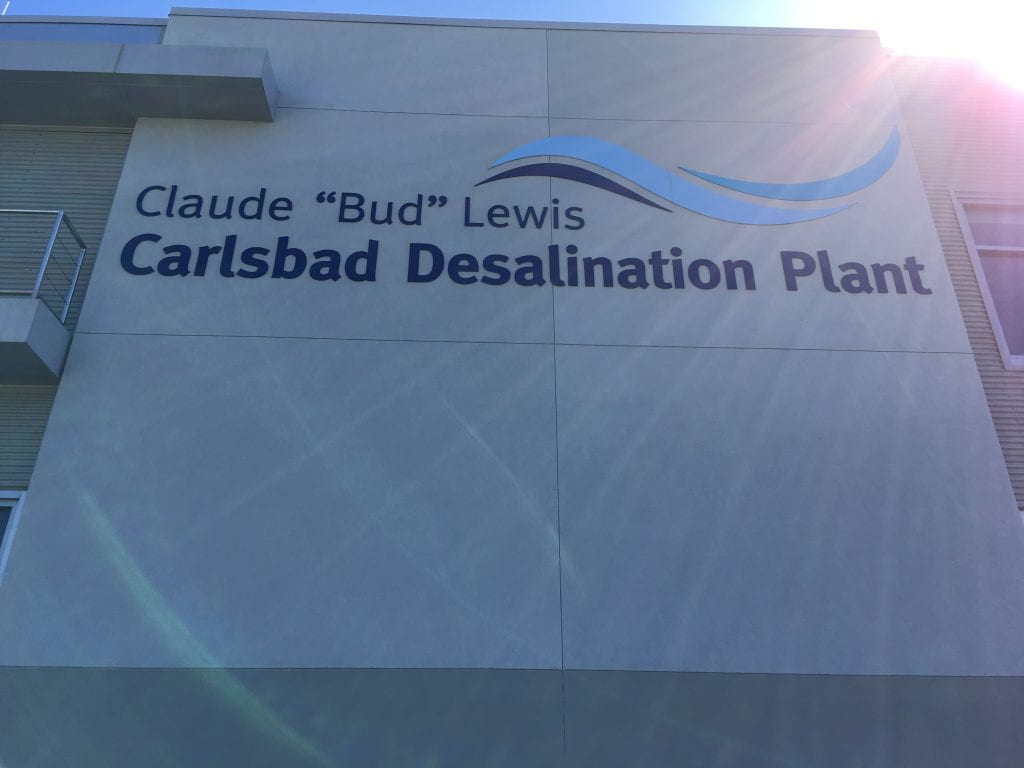
First a little history. Seeking an “all of the above” approach to water, in 2012 the SDCWA entered into a 30-year contract with Poseidon Resources (also called Channelside Water Resources, now owned by Aberdeen Standard Investments, a UK based firm), which owns and manages the Claude “Bud” Lewis Carlsbad Desalination Plant, to purchase desalinated water. Under the terms of this “take-or-pay” agreement, SDCWA is obligated to purchase at least 48,000-acre feet of water per year until 2045 (the plant became operable in 2015). As of fiscal year 2025, Old “Bud” Lewis sold his water for $3,500 an acre foot. For comparison, in 2023 the Voice of San Diego reported that an acre foot of water purchased from the Imperial Irrigation District as part of an earlier historic, landmark deal to secure long-term water for the region, was just $730 an acre foot.
The water authority forecasts that the combined deals with the Eastern and Western water districts will generate revenues of $660 million between now and 2047. That’s great, but for fiscal years 2025-26 and 2026-27 SDCWA budgeted $316 million for the purchase of desalinated water, not including costs for treatment. The amount was $268 million for the two prior fiscal years. Assuming continued expenditures at those amounts, SDCWA must pay billions of dollars on the remaining two-decade term of its agreement with Poseidon/Channelside/Aberdeen.
And the impact on rates? Despite some of the rosier claims, the SDCWA only goes as far as to say that “[r]evenues generated through those agreements [will] help reduce wholesale water rate pressures for San Diego County customers.” (italics added). I read that to mean, that rates will still go up, but perhaps not as much as they might have. And, just this week, citing these water transfers, SDCWA announced water rate increases that are below the national inflation rate. Hoorah!
But although the water authority is portraying these deals as some kind of altruistic endeavor or the result of its foresight and business acumen (an FAQ on the deals characterizes its obligation to pay for overpriced water it doesn’t need as an “investment”), the simple fact is that SDCWA miscalculated the region’s needs and got stuck with a lot of very expensive water that it now needs to do something with.
That something is to offload the desal water to other water authorities in the West. Hence the hullabaloo over the historic, landmark water transfers and exchange programs.
Don’t get me wrong. I don’t doubt that the board members and staff at SDCWA were operating with all due consideration when they committed to buying desal water the region ended up not needing (and at a premium). And, in their defense, water policy in the West is complex, and the consequences of not having enough water—at any price—would have been catastrophic.
But as a ratepayer, I object to the sleight of hand. Don’t tell me you’re doing this great thing out of the goodness of your heart when you’re really just trying to fix your mistakes, especially when the impact of all this hocus pocus to ratepayers is still largely TBD (despite the proposed under inflation rate hike). I mean, SDCWA still touts its agreement with Poseidon as “[a] landmark public-private partnership.” Which I guess it was, but so was the sale of Manhattan by the Indians.
Furthermore, the exact nature of these transfers is, well, as turbid as Colorado River water. I’ve read some variation of the following:
- SDCWA is going to sell Colorado River water it doesn’t need and use those revenues to offset the cost of desal water.
- SDCWA going to engage in “paper transfers” of water, “meaning agencies would access supplies through existing infrastructure and avoid costly new infrastructure.” These purchases would be for desalinated water from the Carlsbad plant and would also generate revenues to offset the SDCWA’s costs for desalinated water.
- SDCWA is going to sell desal water and use the proceeds to produce even more desal water to sell to districts, or as the SDCWA puts it “[allow] shared financing of new supply projects that, through operational flexibility, could provide water to participating agencies when they need it most.” The Los Angeles Times put it more bluntly “the Carlsbad desalination plant could be expanded to transform more seawater into drinking water, thereby freeing up additional water to be traded to cities that need it.”
Granted, this is all early stages and the MOU for the interstate exchanges is just an exploration of a framework, but it’s the last option above that I find the most intriguing because the not so unspoken premise is that SDCWA plans to not only “offset” the costs of the desal but become a water broker in the process.
In a recent interview with NPR, Meena Westford, director of imported water at the SDCWA, insisted that “this is not horse trading Colorado River water.” But despite protestations to the contrary, horse trading (and a lot more) is exactly what Dan Denham, SDCWA’s executive director, seemed to have in mind just a few short years ago.
Speaking to the Voice of San Diego in 2023, Denham said “The Water Authority needs to think more transactionally. So, who are partners out there with needs for what we have, High priority drought-proof water, and can we offer it at a price they’re willing to pay?”
A spokesman for SDCWA said he could not speak to Denham’s previous statements.
But Denham has continued to make similar comments. As recently as March of this year, the Los Angeles Times indirectly quoted Denham as saying:
…the plant is operating at less than full capacity, Denham said, and its output could be increased to provide a larger share of the region’s water if agencies in other states bought some of the Water Authority’s Colorado River water. Essentially, it’s too expensive to run the plant at full capacity given the availability of other more economical supplies, but out-of-state money could make it worth the agency’s while and reduce costs for ratepayers.
In future years, he [Denham] said… with additional investment in upgrades, the Carlsbad desalination plant could be expanded to transform more seawater into drinking water, thereby freeing up additional water to be traded to cities that need it.
Maybe it’s just me, but this sure sounds like a lot more than SDCWA doing God’s work by sharing San Diego’s embarrassment of water riches with the needy. Based on Denham’s comments, both direct and indirect, made in a couple of articles over the space of two years, you’d be forgiven for thinking that the SDCWA wants to become not merely a customer of, but a stakeholder in, the Claude “Bud” Lewis Carlsbad Desalination Plant, which as it so happens, is already owned and operated by a private company.
And, it just so happens that SDCWA will have the option (but not an obligation) to purchase the plant at the end of its 30-year agreement with Poseidon/Channelside/Aberdeen, for just $1. And according to a spokesperson for SDCWA, that’s exactly what SDCWA intends to do:
To quote: “When the term on the WPA [Water Purchase Agreement] expires in 2045, we anticipate continuing operation as “owners” of the facility. This will ultimately be a decision made by our Board of Directors.”
And on its face that seems like a perfectly reasonable proposition. But I’d sure like to know what the implications to ratepayers are if another bet by the SDCWA (the first being the decision to go long on desal purchases) doesn’t work out quite like it planned. One dollar sure sounds like a great deal, until you consider the liabilities of owning an operating a desalination plant that, by SDCWA’s own admission, is already underperforming.
Plus, there’s just something about these transfers that isn’t quite adding up: SDCWA is committed to purchasing high-cost water it doesn’t need so it’s going to reduce its liability by selling that water (so far so good). But then it’s going to use the proceeds of those sales to create even more expensive water it doesn’t need so it can sell that? I mean, if “it’s too expensive to run the plant at full capacity given the availability of other more economical supplies” maybe we don’t need the Claude “Bud” Lewis Carlsbad Desalination Plant at all.
To be charitable, maybe the calculation is that although desal water doesn’t make economic sense for San Diego, as the crisis in the Colorado River basin deepens, other water districts will be so desperate that they’ll have no choice but to purchase it. We can only hope.
Are the water deals—real and theoretical—SDCWA’s attempt at empire building or just its oblique way of saying that San Diego county got stuck with a desal water plant it didn’t need, can’t afford, and—at the end of the day—doesn’t deliver the water it promised and, thus, SDCWA needs to run the place itself? I guess we’ll have to wait until 2045 to find out.
Joe Sheffo is a resident of Encinitas and a former editor at the “North County Times.” More recently, he has worked as an auditor for the State of California, including nine years at the State Auditor’s office.