


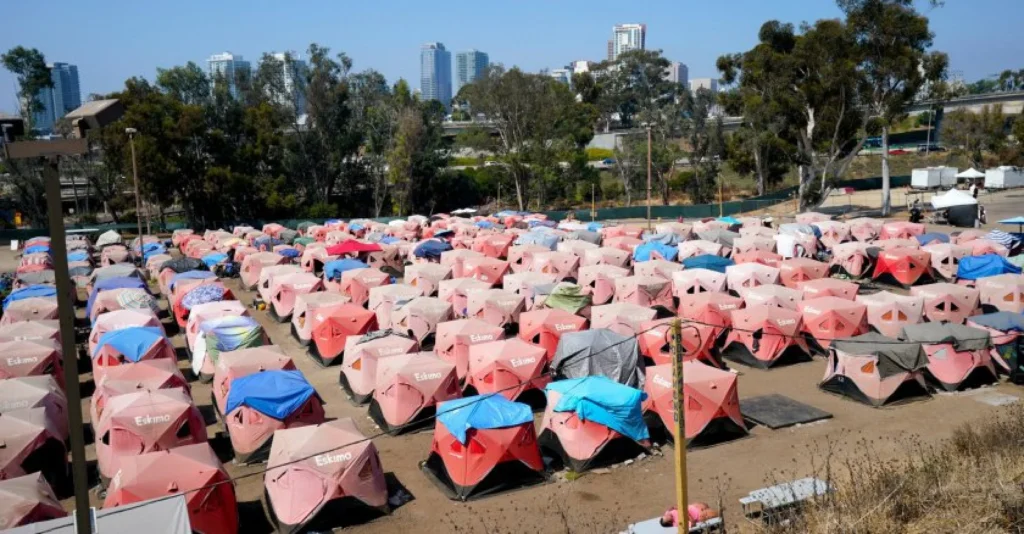


Once renowned for its weather, California now is equally famous for its homeless population, the worst in the United States at more than 187,000 as of 2024. And, apparently, like the weather it is a topic that everyone talks about but no one can do anything about.
Also, like so much of American society—and California in particular—the remedies are more often wish-casting and moral preening than workable solutions. In his 1968 book, “The Unheavenly City,” political scientist Edward Banfield, proffered that public policy is created BY the Upper Middle-Class FOR the Upper Middle-Class:
“The American political style has formed largely in the upper classes….The American is confident that with a sufficient effort all difficulties can be overcome and all problems solved….In reality, the doing of good is not so much for the benefit of those to whom the good is done as it is for that of the doers…”
This “upper middle classification” of public policy tended toward “perversity,” which is why so many of the Great Society programs meant to improve the inner city or assist the hardcore unemployed failed.
In the case of homelessness, the Upper Middle-Class has been drawn to the obvious conclusion: The solution to homelessness must be housing…and therapy.
Proposition 1 (2024), Governor Newsom’s belated effort to address the homeless crisis, proposed to do both. According to the Department of Health Care Services, one part of Prop 1 was to finance (with $6.4 billion in bonds) behavioral health treatment beds, supportive housing, community sites, and funding for housing veterans. The other was to reform behavioral health care funding to prioritize services for people with the most significant mental health needs while adding the treatment of substance use disorders, expanding housing interventions, and increasing the behavioral health workforce. Even before that, according to CalMatters, the State spent nearly $10 billion dollars on homeless efforts between 2018 and 2021.
Prop 1 coincided with the realization—at all levels of the government—that homelessness could no longer be tolerated and, thus, “something must be done!”
So what has been done since then? Or rather, what has been accomplished? Based on conversations with several people with expertise on the issue, the answer is “not much.”
My first call was to Paul Webster, a nationally recognized expert on homelessness. If that name sounds familiar to some of you, it’s because Webster has been local to North County for 20 years. Having grown up in the San Diego area, he went on to work on Capitol Hill. Prior to turning to homelessness, he worked for former State Assemblyman Mark Wyland. Since then, he has served as executive director of the LA Alliance for Human Rights and was a senior policy advisor on homelessness for the U.S. Department of Housing and Urban Development in the first Trump Administration. He continues to provide input to the White House on homeless policy, and is currently a senior fellow at the Cicero Institute, an Austin, Texas based public policy organization.
Webster posited there is evidence suggesting that the homeless numbers are distorted by three populations: Sex offenders, asylum seekers, and people with outstanding warrants.
The Cicero Institute reports that sex offenders make up an outsized proportion of the homeless—as much as 50 percent in some states. In fact, based on counts in 41 states, sex offenders are a larger subpopulation of the unsheltered homeless than the elderly, veterans, or victims of domestic violence. Admittedly, California ranks fairly low in this category at 5%).
Further, a 2025 working paper titled “Asylum Seekers and the Rise in Homelessness” and released under the auspices of the Harris School of Public Affairs at the University of Chicago found that between 2022 and 2024, approximately 60 percent of the historic 43 percent increase in the number of individuals living in homeless shelters (between 2022 and 2024) was driven by new immigrant arrivals seeking asylum. California was not included in the study.
The numbers for parolees and probationers as a percentage of the homeless are a bit dated but still consequential. Santa Clara County’s 2017 Homeless Census & Survey found that 16 percent of respondents reported being on probation or parole at the time of the survey. Based on point-in-time (PIT) counts from 2017 and 2018 and other surveys from the three most populous counties in the state (Los Angeles, Orange and San Diego), California Health Policy Strategies, a Sacramento-based consulting firm focusing on health policy, reported that 13 percent of respondents reported being under community supervision, probation or parole at the time of the survey.
These data points have significant implications. One is that the homeless population as currently comprised may be to some non-neglible degree made up of criminals, sexual deviants and those who should not be in the country at all. Put another way, what I think most people would consider the “core” population of homeless (people with mental health issues, legitimate claims to economic hardship, debilitating handicaps, or serious drug habits) may—in real terms—be much smaller than observed (granted there is a lot of crossover with all of these subcategories).
The other implication is that we should be able to address some not inconsequential portion of the homeless population with conventional law enforcement approaches. The parolees and probationers amongst the homeless population are almost certainly in violation of the terms of their release (by not reporting into their “POs,” drug use, associating with other ex-convicts, etc) and should be in jail or prison. The undocumented should be returned to their home countries, and the “asylum” seekers (the term has lost all meaning thanks to the Biden administration) should never have been extended that classification in the first place. Although it is not a popular position, laws that restrict sex offenders from living within a certain proximity of a school, park, or a daycare facility should be reconsidered. Sex offenders are more often family members or friends than strange men lurking in the shadows. In fact, a 2000 U.S. Department of Justice funded study found that more than 90 percent of sexual assaults against juveniles was committed by a family member or acquaintance. The overall percentage for juveniles and adults was 86 percent.
Next, I reached out to Estela Lopez, the executive director of the L.A. Downtown Industrial Business Improvement District (BID), which includes the 50 or so blocks that make up Skid Row. Most BIDs organize the annual street faire, print posters for the “Taste of Whatever” event, and engage in some beautification efforts. The LA Downtown BID is forced to do the job that in many ways the rightful authorities have abandoned. For instance, it collects 8 tons of trash…A DAY! (The following is based both on my phone conversation with Lopez and an extended podcast interview she recently did with Meghan Daum on the Unspeakeasy.)
Lopez grew up in the downtown neighborhood that currently makes up Skid Row in the 1950s and ‘60s, where her father had a tailor shop. Even then, there were “winos,” mostly middle-aged white men who would pass out on the streets with a bottle in their hands. The problem metastasized in the 1970s and ‘80s in part as a result of redevelopment efforts in more desirable parts of downtown. Perhaps because she is forced to deal in reality and not the therapeutic rationalizations and “rights talk” (to borrow a phrase) of the homeless activists, Lopez is not afraid to use blunt language about the situation: Skid Row is the product of “societal breakdown;” the area is a “hellscape” with unimaginable “depths of depravity;” society should be “offended and scandalized” by the conditions.
When I asked Lopez, who has held the job for about 25 years, what had changed since the passage of Prop 1 and the Supreme Court ruling (also dating to 2024) upholding local ordinances that bar camping on public property, her response was immediate: “The problem has gotten worse.”
Some of what Lopez said tracked with developments identified by Webster. When I asked her how the homeless population had changed over the past several years, she explained that around 2023 there had been an influx of women with children from Central and Latin America. Their exact immigration status (undocumented or asylum) is, of course, unknowable. According to Lopez, they reported coming over at the San Diego section of the border because it was more lightly enforced than parts farther east. People in San Diego told them to go to Los Angeles because there were more services. They mostly live as a group in about 70 RVs.
As for all the new housing, turns out that Housing First comes with its own set of problems. The dysfunction of the streets just moves into those deluxe apartments in the sky, which become dens of drugs and prostitution. The lobby security guards are completely powerless. What we might call the sympathetic homeless who reside in those buildings live in fear of the feral monsters.
When I asked about the tiny homes I so often hear about, Lopez said that there was such a “development” in the suburb where she lived, but it was on city land, so things were kept under control. She understood that elsewhere they just became magnets for homeless generally, creating the same problems experienced on Skid Row (just like the apartments).
Another anecdote that aligns with Webster’s perspective concerns parolees and probationers. Lopez related that in the mid-aughts, William Bratton, then chief of the LAPD, cracked down on people out on warrants. According to Lopez, the homeless population in Skid Row dropped from 2,000 or so to a “manageable” [my characterization, not hers] 700. That effort ended after lawsuits by the homeless “advocates.”
When I asked about reliable numbers, Lopez said that the “point-in-time” (PIT) counts that have become an annual tradition in many cities are unreliable because they rely on volunteers who are unlikely to aggressively go hunting down homeless. A study by the Rand Corporation supports that PIT counts, which are the official counts upon which federal funding is determined, have underestimated the homeless, at least in the LA region.
A little closer to home, I reached out to Aaron Byzak, CEO of Solutions for Change, a Vista-based organization that provides a highly structured, nearly two-year program for families experiencing homelessness. Participants have to apply to the program. They must have children, be sober, and can’t have serious untreated mental health issues. If accepted they are drug tested regularly. It’s this last detail that makes Solutions ineligible for state and federal funds (although that’s beginning to change under the Trump administration).
Well regarded regionally as a leader in healthcare and with direct experience with homelessness throughout his multifaceted career and personally through a close relative, Byzak is blunt but nuanced when it comes to describing the current state of homelessness, at least from his vantage in North County: while the point in time numbers may reflect some change, on the ground, homelessness is not getting better. Housing First is a failure as a one-size-first-all policy approach to an issue as complex as homelessness. Providing housing without mandatory treatment programs is simply warehousing people hoping they will magically get better. Tiny houses are not a long-term solution because under Housing First funding mechanisms, treatment services are not mandatory. He likens the facilities involved to housing people in sheds that are available at Home Depot—clearly not a long-term solution. The availability of fentanyl, a major contributor to the drug and homelessness crisis, may have decreased due to Trump’s border crackdown, but the impact of high potency marijuana and meth as major contributors to psychosis continues. North County cities have been good about cracking down on encampments since the recent Supreme Court decision, but generally coordinated efforts have been difficult. “Homelessness is a complex puzzle, but how can we put it together if we can’t agree what the picture [on the front of box] is?”
My quest to determine whether California’s homeless crisis has in anyway improved seems to have ended where it began: Despite billions of dollars directed to the effort, favorable court rulings, and the general consensus that “something must be done,” homelessness is as bad as ever.
Any idea to the contrary is a sign of a kind of societal delusion. As Banfield pointed out a half-century ago, Americans—particularly upper middle-class elites who have very particular experience and mistakenly think others share their perspective—have been conditioned to believe that any social problem can be fixed through government effort (or I guess now, some kind of public/private partnership) and that to not attempt such an amelioration is immoral. If the initial efforts fail it only means that we didn’t spend enough money. Thus, the more government fails, the more the public (and the bureaucracies and the non-governmental organizations) demands more government.
This is nowhere better captured than in the comments of Tamera Kohler, the CEO of the San Diego Regional Task Force on Homelessness (RTFH), who had the temerity to say of a 1 percent net decrease in the County’s 2026 PIT homeless counts (the difference between sheltered and unsheltered) “This is what progress looks like.” And then of course came the eternal plea, the dream that will not die:
“We’re seeing good results where we’ve made investments. As a region, we still do not have enough housing resources — there are no more housing vouchers, and HUD funding is uncertain. So the investments have been in diversion, sheltering, and encampment resolutions. When we have adequate investments, we can reduce unsheltered homelessness.”
The San Diego Regional Task Force on Homelessness has received nearly $100 million in “public support” between 2020 and 2024. Kohler herself made $275,000 in fiscal year 2025 year. When I reached out to RTFH to inquire how much “investment” would be adequate to “reduce” homelessness and what the reduction would be, I received a non-response response.[1]
And we can go down the list of other such delusions:
- That education will solve the world’s social ills;
- That poverty can be eliminated;
- That unlimited immigration is an unmitigated good;
- That we can invade backward countries and turn them into liberal democracies;
- That people really do want to take public transportation.
The “spend billions, build housing, solve homelessness” is only the latest, and I hope last, such delusion, if only because we’re running out of billions.
Policymakers, and in some cases the public at large, are not willing to do the obvious things that could reduce the number of homeless without major expenditures or new programs. Cities and counties are unwilling to track down ex-cons in violation of their probation/parole because of the protests of a vocal minority of homeless and civil rights advocates. People have a natural but misplaced fear of sex offenders, the remedy for which has resulted in the streets being flooded with them. Even more outrageously, our so-called “leaders” embrace certain follies such as blanket asylum for anyone on Earth with a hard-luck story that contributes to the domestic homeless population. And, as everyone I spoke to stressed, you cannot treat the homeless problem without demanding changes in behavior on the part of the homeless.
Oh, and by the way, as for Prop 1, you’ll be shocked to learn that, as of March of this year, none of the various bond-funded projects expected to be completed in the first year (2025) have been.
Joe Sheffo is a resident of Encinitas and a former editor at the North County Times. More recently, he has worked as an auditor for the State of California, including nine years at the State Auditor’s office.
[1] “ Tamera has always said a dedicated funding source would help a lot. We know the homelessness response system here in San Diego County works. Every day people exit the system and move back into housing, and some months we see that trend hold—more people exiting than entering over a 30-day period. We just saw that in June.
The problem is the system is overwhelmed for a variety of reasons—job loss, eviction, injury, lack of housing options, cost of living. Too many people continue to fall into homelessness, but we know when we invest in system we see positive results.”